Pages

Monday, December 21, 2015

Eisenstein in Guanajuato

The Oscars be damned! Eisenstein in Guanajuato, the latest masterpiece from British master Peter Greenway is the best picture of the year 2015. At least, it should be. In Greenway’s astute hands a drab, award-baiting subject (after all, we are talking about the Russian master of silent cinema, his repressed homosexuality, and those bloody communists!) becomes a carnival of sex. It’s irreverent, chatty and shameless, with full of full frontal.

This movie will not play in a theatre near you!

/

Set in Mexico during the “10 days that shook” Russia’s greatest silent filmmaker, “Eisenstein in Guanajuato” marks Peter Greenaway’s raucous attempt to capture his all-time cinema idol at his moment of greatest personal discovery and deepest professional frustration — which, the film takes great delight in suggesting, coincided with the loss of his virginity, at age 33, so far from his (still) homophobic homeland. Determined to breathe fresh life into a medium he insists has scarcely evolved in the 90 years since Sergei Eisenstein made “Strike,” Greenaway has wrought an outrageously unconventional and deliriously profane biopic that could take decades to be duly appreciated.

Unspooling like some sort of blasphemous passion play, the film depicts Eisenstein’s symbolic death and subsequent resurrection via an act of gay sex. “Somebody has opened the door to a wet and weepy dirty hurricane,” the Russian gushes not long after his studly Mexican guide, Palomino Canedo (Luis Alberti), pours olive oil down his backside and forcefully mounts him. It’s a scene that makes “Last Tango in Paris” seem tame by comparison, crowned by the sight of Canedo planting a tiny Soviet flag in Eisenstein’s bleeding orifice.

More Here/

/

Eisenstein in Guanajuato is far from a conventional biopic. It hones in on the director’s time abroad working on his eventually abandoned project about the Mexican revolution ¡Que viva México!, which had been backed by left-wing American benefactor Upton Sinclair and his wife after Eisenstein struggled to get a film off the ground in Hollywood.

Eisenstein’s relationship with the Sinclairs broke down amid Stalin’s suspicions that the director had deserted the USSR – and his distraction by more carnal pursuits.

But Greenaway makes production tensions mere background to the very personal tumult of Eisenstein’s intense affair with his guide Palomino Cañedo, to whom he lost his virginity at the age of 33. This is framed as nothing less than a personal revolution – the “ten days that shook Sergei Eisenstein”, as Greenaway mischievously refers to them in a play on the director’s commemoration of the Russian Revolution, October (Ten Days that Shook the World).

“I always felt Eisenstein’s first three films were very different from the last three – why? I think the answer to that is, when you go abroad, you become a different person,” said Greenaway, who believes the personal transformation Eisenstein underwent in Mexico turned him from the focus on mass action of Battleship Potemkin, Strike! and October to a greater concern with the individual, as evidenced in Alexander Nevsky and the two-part Ivan the Terrible.

“He was away from paranoia, from Stalinist persecution and really strange political eccentricities, and he was faced with a brand new and different society. There’s a lot of evidence he freed up, and became much more empathetic to notions of the human condition.”

More Here/

/

Peter Greenaway, CBE (born 5 April 1942) is a British film director. His films are noted for the distinct influence of Renaissance and Baroque painting, and Flemish painting in particular. Common traits in his film are the scenic composition and illumination and the contrasts of costume and nudity, nature and architecture, furniture and people, sexual pleasure and painful death.

More Here/

Friday, December 18, 2015

The Hateful 8

The close-up was always Hollywood’s answer to the portrait, but the spaghetti western turned it into a landscape. When Sergio Leone first zeroed in on Clint Eastwood’s narrowed eyes and gritted teeth in A Fistful of Dollars, he wasn’t just showing off his leading man’s face – he was revealing the craggy topography of his soul.

For the trick to work, you need time, the right cast, and some very wide-angle lenses to drink the details in – and the stately, imperious, pyrotechnically thrilling new film from Quentin Tarantino has all three in ludicrous supply.

More Here/

/


Tangerine

Little is as it seems in “Tangerine,” a fast, raucously funny comedy about love and other misadventures. That’s true of its main attractions, a pair of transgender lookers with motormouths and killer gams, as well as the nominally straight men occupying their hearts and minds. Appearances both deceive and delight in this tough yet tender, gritty yet gorgeous movie, which was made with ingenious skill and what would count as chump change at the big studios. Shot along a grubby stretch of Los Angeles, it takes place in the looming shadow of the Hollywood sign, but as far from industrial cinema as another galaxy.

That much is obvious the moment the movie opens on Sin-Dee Rella (Kitana Kiki Rodriguez) and Alexandra (Mya Taylor), face to face in a doughnut shop, a single sprinkled confection grandly set before them. Tight friends, Sin-Dee and Alexandra share much in common, including a taste for sweets, a weakness for men and absolute faith in the transformational power of a luxurious wig. Given the girl talk and high-pitched shrieks of laughter, you may not immediately notice that the women are transgender, with identities that speak to the cultural moment. “Tangerine” encompasses dizzying multitudes — it’s a neo-screwball chase flick with a dash of Rainer Werner Fassbinder — but mostly, movingly, it is a female-friendship movie about two people who each started life with an XY chromosome set.

More Here/

Son of Soul

The Auschwitz-Birkenau-set “Son of Saul” opens at the start of a work shift, when a few men with red X’s painted on the backs of their coats herd a large group of new arrivals indoors, reassuring them that they’ll soon be fed and given job assignments. The camp’s newcomers are told to strip and pick up their clothes and belongings after their group shower — from which, of course, they’ll never emerge.

The marked men wait on the other side of the shower door for the screams to stop so they can resume their work as the Sonderkommando, Jews tasked with the grunt labor of carrying out Hitler’s Final Solution.

That five-minute preamble is a harrowing and brilliant sequence, encapsulating the Nazis’ brutally efficient approach to genocide. Cinematically, though, it’s most notable for director László Nemes’s extreme close-up throughout of Sonderkommando Saul (Géza Röhrig), whose face is a mask of silent detachment.

More Here/

/

Possessed by the same single-minded intensity that drives its protagonist’s every step, “Son of Saul” plunges the viewer into a hell that exists beyond the limits of comprehension or representation. A terrifyingly accomplished first feature for 38-year-old Hungarian writer-director Laszlo Nemes, this indelible portrait of Auschwitz in the latter days of WWII sticks to the limited vantage of a Jewish prisoner who, immune to either hope or fear, becomes bent on carrying out a single, desperate act of moral survival. The result is as grim and unyielding a depiction of the Holocaust as has yet been made on that cinematically overworked subject — a masterful exercise in narrative deprivation and sensory overload that recasts familiar horrors in daringly existential terms. Further festival bookings, post-screening arguments and a narrow commercial life are assured for this rare debut film to secure a competition berth at Cannes.

More Here/

/

A season in hell is what this devastating and terrifying film offers – as well as an occasion for meditating on representations of the Holocaust, on Wittgenstein’s dictum about matters whereof we cannot speak, and on whether these unimaginable and unthinkable horrors can or even should be made imaginable and thinkable in a drama. There is an argument that any such work, however serious its moral intentions, risks looking obtuse or diminishing its subject, although this is not a charge that can be levelled at Son of Saul.

By any standards, this would be an outstanding film, but for a debut it is remarkable. Director László Nemes’s film has the power of Elem Klimov’s Come and See – which surely inspired its final sequence – and perhaps of Lajos Koltai’s Fateless. It also has the severity of Béla Tarr, to whom Nemes was for two years an assistant, but without Tarr’s glacial pace: Nemes is concerned at some level with exerting a conventional sort of narrative grip which does not interest Tarr.

Son of Saul is set in the Auschwitz-Birkenau death camp in 1944, and one Hungarian Jewish prisoner named Saul (played by Géza Röhrig) is a member of the Sonderkommando, a group of prisoners given humiliating and illusory privileges as trusties, with minor increases in food ration in return for their carrying the bodies from the gas chambers to pyres to be burned, then carting the ashes away to be dumped. The task is carried out at a frantic, ever-accelerating rate around the clock, as the Allies close in. Among the dead, Saul discovers the body of his young son, and sets out to find a rabbi among the prisoners to give the boy a proper burial in secret, using pleas, threats, blackmail and bribes – with jewellery (called the “shiny”) that he steals from the bodies – to achieve his aim. Saul’s desperate mission is carried out with the same urgent, hoarse whispers and mutterings as another plot in progress: a planned uprising, which Saul’s intentions may upset. And all the time, the Sonderkommando are aware, through this network of whispers, that they themselves will be executed in due course by their Nazi captors.

More Here/

Queen of Earth

When you first see Catherine, she’s looking upward, her teary, blotchy face filling the frame. She’s suffering, all right, you better believe it, although she doesn’t seem to be doing a particularly good job of convincing the guy who’s mostly off-camera. She looks like a mess — pathetic, really, with her smeared black eye makeup and the tears that just keep pooling and dribbling. The funny thing is that with her wet raccoon eyes and red nose, Catherine — a sensational Elisabeth Moss — also looks like a sad clown. All that’s missing is the black velvet background.

By the time Catherine exits “Queen of Earth,” her frown has turned upside down and a grimace of abject misery has transformed into a vision of manic happiness as if she had traded in her tragedy mask for a comedy one. That it’s unclear which face is scarier, more unnerving, is in keeping with the director Alex Ross Perry’s gift for destabilization, for setting a mood only to violently upend it with cutting looks, dissonant musical chords and off-kilter camera angles. That Catherine seems to be swapping theater masks even as Ms. Moss brings tremendous depth of feeling to the role is in line with the arch self-consciousness of “Queen of Earth,” an art film in quotation marks.

More Here/

/

If Alex Ross Perry’s previous film, “Listen Up Philip,” aspired to the kaleidoscopic narrative density of a John Fowles or William Gaddis, his new “Queen of Earth” carries the spiky intensity and tart aftertaste of a John Cheever short story, as it observes the psychological breakdown of a young woman coping (badly) with a series of abrupt life changes. An unnerving, acidly funny work that fosters an acute air of dread without ever fully announcing itself as a horror movie, Perry’s fourth feature may unfold on a smaller canvas than the expansive “Philip,” but is every bit as sure of what it wants to do and how to get there, built around an utterly fearless central performance by Elisabeth Moss. Audiences who found Perry’s earlier work misanthropic won’t want to touch “Queen” with a 10-foot pole, but heartier souls — and connoisseurs of uncompromising auteur cinema — should rise to the occasion.

A deep-dish cinephile with a pronounced affection for late 1960s/early 1970s alt-Hollywood cinema, Perry is working this time in a style that seems equally influenced by doppelganger narratives like Bergman’s “Persona” and Brian De Palma’s “Sisters,” as well as by the claustrophobic domestic terror of “Repulsion” and Chantal Akerman’s seminal “Jeanne Dielman.” (Perry himself has also cited Woody Allen’s “Interiors” as a key influence.) Here, the obligatory woman on the verge is Catherine (Moss, also credited as a producer), who comes to spend a week of self-imposed “exile” at the lake house of her best friend, Virginia (Katherine Waterston), following the death of her father and a bad breakup from her longtime boyfriend. We are somewhere in the tranquil Hudson River Valley, and the silence is deafening.

More Here/

Macbeth

If Roman Polanski’s 1971 Macbeth was essentially a witchy Manson-era horror movie, then Snowtown director Justin Kurzel’s screen rendering of “the Scottish play” is a spittle-flecked war film full of post-Braveheart mud, warpaint and Kurosawa-style heroic bloodshed. The tale is bookended by battles – faces meatily pummelled, bones crunchily broken and throats spurtingly sliced as offstage conflicts are placed centre-screen. Michael Fassbender plays the future king of Scotland as a rugged warrior coming apart at the seams, his ancient anguish apparently born of very modern post-traumatic stress. There’s a talismanic family bereavement too, which places an aching emptiness at the centre of his marriage and further bolsters his hollow-eyed descent into hell. As a result, Marion Cotillard’s Lady Macbeth is both more sympathetic and more sidelined than one might expect, no longer the driving force behind the bloody deeds, more a damaged partner in crime.

Smoke- and mist-strewn vistas abound, with every meeting placed atop a scenic ridge or an imposing weather-beaten moor; this is very much Shakespeare in the wild, its poetry visual rather than verbal. Executions are rendered as theatrical public burnings and Birnam Wood comes to Dunsinane in fiery fashion. At times it looks a little like Shakespeare meets 300, a fitting training ground for Kurzel and Fassbender’s forthcoming collaboration, the eagerly awaited computer-game adaptation Assassin’s Creed.

More Here/

Goodnight Mommy

Ever since it debuted at last year's Venice Film Festival, the Austrian import "Goodnight Mommy" has been building up a reputation as a horror exercise of the highest order—the kind of film that could supposedly reduce even the hardiest of observers into quivering blobs of jelly squirming in their seats, partly out of what is happening on the screen and partly out of fear of what might be coming just around the corner. As someone who has seen more than his fair share of such films that have failed to live up to their hype over the years, I tend to approach such things with more than a healthy dose of skepticism. In this particular case, the movie in question has more than lived up to its advanced word. In fact, co-filmmakers Veronika Franz and Severin Fiala have conjured an intelligently staged and executed creepfest that takes one of the most universally compelling of notions—the unbreakable bond that exists between a mother and her children—and approaches it in such a formally and narratively bleak manner that it makes the works of fellow countryman Michael Haneke seeming almost benign by comparison.

As the film opens, 10-year-old twin brothers Lukas and Elias (played by real-life twins Lukas and Elias Schwarz) are playing tag in the cornfield outside their isolated home while waiting the return of their mother (Susanne Wuest) from facial surgery. In theory, this should be a joyous time but from the moment she returns home, her head completely swathed in bandages, it quickly becomes apparent that something is not quite right. Instead of the warm and cheerful presence that she apparently was before going away, she is now as cold and remote as the house they uncomfortably share (with its brutally sterile air and large supply of unnerving nooks, crannies and hallways, it seems to have been designed by the people who did the residence of the good doctor from "The Human Centipede") and demands constant quiet and no sunlight to help aid in her recovery. To make matters even more off-putting, she has begun to clearly favor Lukas over Elias, even going so far as to refuse to even speak to the latter for unknown reasons.

More Here/

/

Squirming just below the surface of Goodnight Mommy, a nerve-shredding new thriller from far-flung Austria, is an almost comically predictable plot twist. Moviegoers hip to the true identities of Tyler Durden and Keyser Söze should figure it out by the end of the first reel, when the filmmakers have already begun to show their hand. But you don’t go to a midnight movie to have your mind blown. You go to have your stomach churned, your hairs put on end, your fingers forced over your eyes. And by that base criteria, this elegantly nasty little potboiler should satisfy those brave enough to brave it. They might see the big reveal coming, but that won’t help them unsee the horrors leading up to it.

Nearly all of the film takes place in a secluded country house, surrounded by an idyllic forest and vast cornfields, perfect for frolicking and fleeing. This is the new home of 9-year-old twins Elias (Elias Schwarz) and Lukas (Lukas Schwarz), as well as their mother (Susanne Wuest), an anchorwoman who’s just undergone cosmetic surgery. To these troublemaking boys, there’s something not quite right about Mommy: Beyond her strange, frightening appearance—a pair of bloodshot eyes peeping out from behind a mask of bandages—she just seems different. For one thing, she’ll barely acknowledge Lukas’ existence, addressing only Elias and providing the boys with a single dinner, one set of clothes in the morning, etc. Soon, the brothers begin to wonder if it’s someone else entirely under all that gauze—if, in fact, their mother has been replaced by a malevolent imposter.

More Here/

Chi-raq


Provocatively using Aristophanes' ever-timely 2,426-year-old play Lysistrata as a way to address the ongoing plague of shootings on the South Side of Chicago, Spike Lee serves up an odd gumbo teeming with political activism, broad melodrama, verse dialogue, rap music, history lessons, comedic caricature, moral guidance and steamy sex (later withheld) in Chi-Raq.

Even if the now-veteran director lays everything on a bit thick, repeatedly makes many of the same points and lets things go on too long, he's still found a lively and legitimate way to tackle an urgent subject matter that other filmmakers have found excuses to avoid. This is the first feature film out of the gate for the nascent Amazon Studios, which seems at least initially dedicated to working with interesting directors on projects the studios may not be inclined to take on. Far more people will end up seeing the film once it's available at home, but initial theatrical runs in major urban markets beginning December 4 will effectively establish its public profile.

As far as big screen features go, in the decade since his last big commercial success with Inside Man, Lee has stumbled with several unlikely and/or ill-advised projects, from Miracle of St Anna and Red Rock Summer to Old Boy and last year's Da Sweet Blood of Jesus, none widely seen. The least you can say about Chi-Raq, a title at which Chicago mayor Rahm Emanuel has taken offense, and too bad for him, is that it vaults Lee back into a position of cultural/political relevance similar to that which he held a generation ago, just as it sees him making some bold creative moves, especially with the dialogue, that are pretty fresh.

More Here/

Thursday, December 17, 2015

Ah, the new issue of ‘Indian Literature’, the Sahitya Akamedi’s Bi-Monthly Journal (Sep/Oct 2015; issue 289) is on my desk, and I cannot stop smiling. The issue, titled, ‘India Under 40’, opens with the English translations of Assamese poems by two of my friends, Bijoy Sankar Barman and Kamal Kumar Tanti. The issue also features an incisive article on women in Assamese writing by Arindam Borkakati, whom I used to know when we were doing our Masters. Can I just add that I had whale of a time translating Kamal’s challenging and intriguing poems?

The vanished path illuminated by drawings

Review of The Vanished Path: A Graphic Travelogue by Bharath Murthy (New Delhi, HarperCollins Publishers, 2015)

By Dibyajyoti Sarma

With the air rife with cultural dissent, this is perhaps the right time to read and appreciate Bharath Murthy’s breezy and sharp Manga-like graphic novel The Vanished Path.

While Buddhism remains the fastest-growing religion in the world, it’s ironic how in the country of its origin, the teachings of the Buddha is largely forgotten. Today, we discuss Buddhism in the context of the Dalit issues, as political shorthand for caste issues and that’s that.

Yet, the historical Buddhist sites, from Gaya to Sarnath, dotting Uttar Pradesh and Bihar, are the major tourist destinations visited by thousands of Buddhists from all over the world. These locations are part of the Indian geography, yet they seem to exist in a separate time-space continuum, where the idea of the ‘real India’ is suspended.

What happens when a recently converted Indian Buddhist travels to these sites? This is what The Vanished Path is all about.

After his conversation, Murthy, who teaches film direction at the Film and Television Institute of India, Pune, undertakes a journey from Sarnath to Nalanda, accompanied by his wife Alka, and returns to document his experiences in the form of a graphic novel.

It is the graphic element that gives the book, which has been nominated for Shakti Bhat First Book Award, its heft and power. Murthy is clearly inspired by the art of the Japanese Manga comics, which celebrates black and white line drawings, focusing on impressionistic description than real representation.

So, we have the couple navigating their way through hinterland India, by train, taxi, auto and other means, meeting assorted characters on the way, and visiting the landmarks associated with the life of Siddhattha Gotama. This modern track is interspersed with historical facts and musings from Buddha’s life.

Murthy’s narrative is largely straightforward. He goes, observes and reports. Yet, the political undertone is unmistakable. It is no accident that he is in Varanasi on the day the Ayodhya dispute verdict was to be announced. He observes how Buddhist Asian countries have invested heavily on these sites. He meets a Dalit kitchen help in one of the lodges, who tells him that though he is Buddhist, he did not really know the teachings of the Buddha.

Yet, what’s fascinating about the book are the drawings, the monuments, the scenes from rural India, and even the retelling of Buddha’s life. In all this, Murthy makes a curiously interesting choice of representing Buddha not as human, but as the dharma wheel.

While the country is seeing resurgence in publishing in the recent years, we still have very few graphic novels. For this reason alone, The Vanished Path is an important book, and the best part is that you can finish it on one sitting.

(In the years, HarperCollins India has published some groundbreaking graphic novels, including Amruta Patil’s dazzling Adi Parva. For the best Japanese Manga based on India, check out Yukichi Yamamatsu’s Stupid Guy Goes To India.)

(The book review was first published in Sakal Times.)

'Every city should have a shelf full of detective novels dedicated to it’

‘Every city should have a shelf full of detective novels dedicated to it’

Author of Swedish origin, Zac O’Yeah, who has made Bengaluru his home, talks about his new novel, Hari: A Hero for Hire and explains why it is equivalent to a popular masala movie.

How did you think of a working class sleuth in the cyber capital of India?
Well, if I hadn’t stepped off the train at City Junction station, Bengaluru in 1992 and checked into the cheapest lodge in the Majestic area, I don’t think I would have been a successful novelist today. I spent my days in those nameless second-hand bookstalls that used to proliferate south of Kempegowda Circle, dreaming that I might write a book that would be on display there someday.

Another reason why I chose to set my book series here is because until fairly recently, detective fiction used to be dominated by Anglo-American locations and concerns. Nowadays, you have globally bestselling detective novels set in places like Botswana, Thailand or Sweden. So, why not Bengaluru? I strongly felt that every self respecting city should have a shelf full of detective novels dedicated to it.

Also, having Hari as a reformed tout character seemed like a great idea because a tout would know every nook and cranny of the city. Hari speaks English well, is good at calculations and in many ways a perfect detective. So Hari, the private eye, became my key to unlock the city and chronicle it.

I doubt I could have imagined the character Hari Majestic without Bengaluru, the city where I’ve lived for the last 15 years after leaving Sweden.

You seem to be more interested in how your characters behave than the whodunit.
You’re possibly right. I wanted to avoid creating a stereotypical literary detective — the kind you meet in Swedish or Western detective novels. Over the years, I have seen plenty of Kannada action movies and become a fan of Upendra, the king of local cool and one-liners. I wondered what a literary equivalent of such films might read like. I, therefore, set out to write a romantic tragi-comic thriller in Bengaluru. It seemed like the most logical thing to do.

The book is filled with observational humour.
A detective novel should ideally be out in the streets, taking its reader through narrow alleys, pointing out interesting things to look at and places to visit, and somewhere amongst all that, there will be the clues to cracking the case. Reading the newspapers every day in Bengaluru is an endless source of inspiration. There are so many strange stories reported all the time and so for a novelist, it obviously sets the imagination on fire.

How do you combine crime and comedy?
I have no clue. I personally don’t consider myself a ‘humourist’. It just so happens that everything becomes very weird when I write it down. Essentially comedy and crime should not be combined because it’s a recipe for disaster. Lots of readers find it hard to accept. But in Bollywood films, they are able to combine action movies with humorous elements, or comedies with thrillers, so one needs to try to expand the genre and broaden it by adding comedy.

What’s next for Hari and his sidekicks?
A third book is in the works, it might come in 2017. And in 2016, there’s going to be a movie version of Mr Majestic! The Tout of Bengaluru, the first novel. I have been told that they are writing the screenplay right now and expect to start shooting soon.

(The interview was first published in Sakal Times, Pune on 28 November 2015. View the Story Here.)

A comedy of crime

Hari: A Hero for Hire
Zac O’Yeah
New Delhi, PAN
Pages: 332
Price: Rs 350


Zac O’Yeah’s new novel Hari: A Hero for Hire, like its predecessor, Mr Majestic! The Tout of Bengaluru, has been billed as a detective novel/crime thriller. At one level, it is an accurate description. Yet, this seems to limit the appeal of this comic masterpiece. Hari: A Hero for Hire is not a page-turner whodunnit, but a brilliant comedy of manners, set among the working class community in Bengaluru’s bustling Majestic locality.

Hari Majestic (he is so called because he was discovered under the seat of Majestic theatre) is an orphan and an ex-tout who wants to be a detective, so that he can be a hero and find a girl to marry. He is inspired by mainstream Kannada movies, where the upstart hero always overcomes adversity and wins the girl.

So, after the success in the first case (as described in The Tout of Bengaluru), Hari decides that becoming a detective is his calling. He starts an agency and hires help from his friends: Triplex, a drunk, Gaadi, an auto driver, and Doc, a small-time cyber café owner. Hari also gets a case, to find the secret lover of a married woman. Things predictably go wrong, with the client baying for his blood.

In the ensuring skirmish, Hari breaks his leg and is admitted to a specialty hospital, where bigger mystery awaits, an organ trade racket. And, like a good Sandalwood movie, the long-lost mother must return before we have a wedding and a happy ending!

Never mind the convoluted narrative, the book is joy to read, because of O’Yeah’s sparkling prose peppered with wit and dollops of observational humour. The whodunnit plots aside, the Hari Majestic novel seems to exist solely because O’Yeah, originally from Sweden, has to say things about Bengaluru, his adoptive city.

And, boy, what things! The book is an assault on senses, sound, sight, smell and how we interact with each other, seen from a serio-comic point of view, tongue firmly in cheek. Nothing is sacred in O’Yeah’s prose. Yet, there is an innate understanding and off-hand humour in his description of things that we may take for granted.

I am usually suspicious of foreigners writing about India, because the results tend to be one-sided. But in O’Yeah’s prose, he shows a keen understanding of his characters within their socio-economic milieu. And, the best part is that the author does not laugh at his characters, he laughs with them.

It’s difficult to write good comedy, and it takes a genius to fill pages of a crime novel with humour of all shades. Zac O’Yeah is that writer and Hari: A Hero for Hire is that book.

(This review was first published in Sakal Times, 28 November 2015.)

Monday, December 14, 2015

Tales From Firozsha Baag

Tales From Firozsha Baag is a collection of 11 short stories by Rohinton Mistry about the residents of Firozsha Baag, a Parsi-dominated apartment complex in Mumbai. Mistry's first book, it was published by Penguin Canada in 1987. Although all the stories deal with the same location, many were written without the aim of being collected in the same volume.

Dongri to Dubai

Dongri to Dubai: Six Decades of the Mumbai Mafia is a book authored by Hussain Zaidi who is a former investigative journalist. The book traces the evolution of the Mumbai mafia from a group of thugs and smugglers to the present day mafia dons of organised crime.[1] It traces the journey of Dawood Ibrahim from the by-lanes of Dongri where he first cut his teeth in crime, to Dubai, where he eventually established his empire. The book was adapted into the film Shootout at Wadala by Sanjay Gupta.

The book chronicles the story of notorious gangsters like Haji Mastan, Karim Lala, Varadarajan Mudaliar, Chhota Rajan, Abu Salem, and primarily Dawood Ibrahim from 1947 to 2011.

Dawood Ibrahim was initiated into crime as a pawn in the hands of the Mumbai police and went on to wipe out the competition and eventually became the Mumbai police’s own nemesis.The narrative encompasses several milestones in the history of crime in India, from the rise of the Pathans, formation of the Dawood gang, the first ever supari, mafia’s nefarious role in Bollywood, Dawood’s move to Karachi, and Pakistan’s subsequent alleged role in sheltering one of the most wanted persons in the world.

The story is primarily about how a boy from Dongri became a don in Dubai, and captures his bravado, focus, ambition, and lust for power in a gripping narrative. The meticulously researched book provides an in-depth and comprehensive account of the mafia’s games of supremacy and internecine warfare.

The narrative begins from the period of 1950s when the eras of smugglers like Haji Mastan and Varadarajan Mudaliar flourished. Then it moves to telling stories of the menace of the Pathan gang, the short but deadly span of Manya Surve and the rise and fall of Maya Dolas whose location was tipped by dawood ibrahim himself in order to cut the hands reaching towards him eventually all the events lead to the making of the don - Dawood Ibrahim. It's a story of how a young boy from the streets of Dongri, a police man's own son becomes a fugitive from law to hide in Dubai and never to return to his homeland. All the events mentioned in the book leads to the 1993 Mumbai Blasts which were blamed on Dawood. It explains why Dawood was not entirely the mastermind and how due to political manipulation he went on to be called a 'deshdrohi'.

More Here/

Mafia Queens of Mumbai

Mafia Queens Of Mumbai: Stories Of Women From The Ganglands. You can’t have a more catchy title than that. And writers S Hussain Zaidi and Jane Borges have ensured their narration lives up to the title. From the choice of the women they have portrayed, to the racy style of writing, everything is calculated to make the book a page-turner. And though the writers claim the book is an attempt at accurate and true story-telling, they also admit they have taken literary license in places where they felt it was absolutely necessary to add drama to the story.

And so you have graphic details of a dream where Ustara, a ganglord, visualises three topless Chinese women. “I try reaching for them….They are all equally tempting…and then reach for the one whose breasts are fuller…”

Or take this voyeuristic description of a young girl, Madhu’s first-time ordeal in a brothel when a seth forces himself upon her. “He lifted her ghagra and slid his fingers between her legs, moving them slowly and repeatedly…she tried to hurt him by squeezing his penis too hard…”

One wonders from where the writers got these details. Yes, Zaidi did meet Ustara while helping novelist Vikram Chandra research for his book, Sacred Games, but is it likely that the gangster would have shared his sexual fantasies with a reporter and a writer? Even assuming he had, why did the writers feel it necessary to digress into pages about his sexual exploits, when the reason for him featuring in the book is his relationship with Sapna, the woman he trained to take on the might of Dawood?

In the young girl’s case, where did they unearth the gory particulars from, considering they couldn’t have met her as she was lucky to have been sent back to her village after this one terrifying experience, long before this book was written? Madhu is only a tiny part of a larger story, the story of Gangubai, erstwhile matriarch of Kamathipura, the notorious red-light area of Mumbai.

Gangubai may have cited the freeing of this girl as an example of her sympathetic nature but would she have narrated details of an encounter that happened so long ago?

The story of Monica Bedi, girlfriend of the notorious Abu Salem, is written as a first-person account though Monica refused to part with ‘the copyright’ of her life story.

More Here/

Being India

The spin doctor who came up with the "India Shining" slogan will go down in history as either the country's most prescient socio-political analyst or the biggest conman in Indian politics. While the slogan itself has been discarded by the ruling party in favour of something foreign, the feel-good factor is infecting people in different ways, even the prolific author/diplomat Pavan Varma.

The subtext to Being Indian reads: "The truth about why the twenty-first century will be India's." It is an issue of heated debate in this election campaign but sadly, party rhetoric has robbed it of any value.

Varma's effort is a logical sequel to his earlier book The Great Indian Middle Class. The timing is certainly opportune. Statistics and economic forecasts paint a rosy picture of India's future and, for the first time, the phrase "emerging superpower" has a ring of credibility.

The author's thesis is, however, more rooted in the Indian psyche and the elements that characterise our society. Earlier, these were largely a handicap: the naked pursuit of power, patronage, skewed value systems, negatives that flourished under a flawed system of democracy.

Today, he argues, democracy has taken firm roots because it has proved to be the most effective instrument for the pursuit of power and also because it has empowered people who were earlier denied legitimate representation and provided them upward mobility.


That a Dalit, Mayawati, can become the chief minister of India's most populous state is an example. An unabashedly democratic India, where compromise and co-opting are preferred to divisiveness and self-destruction, is the key to building an Indian century.

Following in the literary ethos of his earlier books, Varma draws extensive parallels from Indian epics and religious texts to flesh out his hypothesis. Indians, he says, have deliberately promoted a spiritual, other-worldly image.

The truth, he says, is that the naked pursuit of wealth is considered dharma. Given the right milieu, Indians can "emerge as the most resilient and focused commercial operators of the new millennium".

More Here/

A Fine Balance

Those who continue to harp on the inevitable decline of the novel ought to hold off for a while. The unique task of the genre, after all, is truthfulness to human experience in all its variety, and thanks to the great migrations of population in our time, human variety is to be found in replenished abundance all around us. The displacements, comminglings and clashings of peoples and cultures have released new energies, strange pollens; indeed, the harvest has barely begun.

Consider Rohinton Mistry, a Parsi, born in Bombay in 1952, who has lived in Canada since 1975. His first book was a widely praised collection of stories, "Swimming Lessons and Other Stories From Firozsha Baag." It was followed by the novel "Such a Long Journey," which received the Commonwealth Writers Prize for best book of 1991. His third book, "A Fine Balance," defies easy categorization. Calling it a domestic novel would not be altogether amiss, provided one added: a domestic novel that refuses to remain within walls.

Set in 1975 in an unidentified Indian city, it opens quietly and builds slowly, starting with a simple, centripetal narrative premise. Mrs. Dina Dalal, a financially pressed Parsi widow in her early 40's, is determined to keep her independence, resisting the options of remarriage or a return to the bullying charity of her brother's household. To make ends meet, Dina takes in a paying boarder, Maneck Kohlah, the son of a Parsi school chum, and hires two Hindu tailors, Ishvar and Omprakash Darji, to sew dresses for an export company. At first she sets the tailors to work under sweatshop conditions. The author charts the transformation of an empty apartment into a home full to bursting, and the binding of mismatched strangers into a communion as close as family.

Each of the four main characters is a refugee from one thing or another. Dina seeks to escape from the suffocating strictures imposed upon respectable, single, aging women. Maneck, the paying boarder, has been sent down from the hill country to attend college. His beloved mountain village in its majestic natural setting has been scarred by road construction and electrification projects, its forests depopulated. Seeking an education in step with the times, Maneck is studying for a diploma in refrigeration and air conditioning, for entry into "an industry that would grow with the nation's prosperity."

The tailors, Ishvar and Om, have been fleeing all their lives; they are refugees from caste and communal violence and, finally, from the institutional violence of Indira Gandhi's emergency rule. Om, just 17, is the son of Ishvar's murdered brother, and Ishvar, in his 40's, who has never married, has dedicated his life to being father-protector to his nephew. Their histories are joined in unending misfortune. Living from hand to mouth (even their sewing machines are rented), entirely at the mercy of the social upheavals of the hour, they are subject to periodic sweeps of the city to provide crowds for political rallies and conscripted manual labor for civic beautification schemes. Each time they are beaten down, they have to pick themselves up and start over. This happens again and again.

Under these circumstances, Dina's apartment becomes a haven for the tailors. The four strangers start sharing their stories, then meals, then living space, until, over the divides of caste, class and religion, the ties of human kinship prevail. In this one shabby little apartment, at least, the human family becomes more than a phrase, a metaphor, a piety. The author takes his own sweet time here, as well he should. I balked at the slowness at first, but just when I'd started to mutter "This really is much too sweet!" and "What are the odds of such harmony coming to be under such conditions?" and "I only wish. . . ." the downslope began, a veritable avalanche of catastrophe ensued, and I keenly regretted my reluctance to bask in the brief patch of sunshine Mr. Mistry had provided.

More here/
Speaking for Myself: An anthology of Asian Women’s Writing

Harry Potter and the Deathly Hallows

This is where the Saga ends.

Legends of India's Rivers

The Story of Madhubala

Ironically Madhubala was born on Valentine’s Day, which is where Khatija Akbar starts her biography, I want to live: The story of Madhubala. Ironically because the woman who queened it over the hearts of millions of Indians had heart problems all her life and had her heart broken by the person to whom she gave it unconditionally.

As the Hindi film world knows, she started her career as Baby Mumtaz at the age of eight, working to make up for the fact that her father Ataullah Khan had lost his job and could not afford to support his family. When she turned sixteen, she became known as Madhubala and her beauty took the screen by storm. So much so that her understated acting went overlooked. People walked onto the sets and were struck dumb by the coup de foudre of her beauty, from Shammi Kapoor to ordinary visitors. Akbar draws comparisons between Madhubala’s impact on Hindi films and Marilyn Monroe’s impact on Hollywood. Both women she says, were victimized because of their beauty and few people could see beyond it. Both had slightly pronounced noses that they tried to minimize in front of the camera.

Unlike Marilyn, however, Madhubala was always the first person on the sets, was generous to her co-workers and rarely threw any of the starry tantrums that most people expected from divas of her stature. Equally surprisingly, she was terrified of crowds and would go shopping in the safe anonymity of a burkha.

More here/

May You Be the Mother of a Hundred Sons

This book grew out of Elizabeth Bumiller's personal experiences during three and a half years in India. Her father had spent three months there in 1956, while making a film about traveling by jeep around the world. Images from the film, such as Hindu worshippers beside the Ganges at Benares, were the basis of her commonplace and banal preconceptions about India.

Although she had read recommended books, "talked to numerous old India hands," and watched such popular films as "The Jewel in the Crown" and "Gandhi," upon arrival she felt "like an innocent unworthy of what was before me," she acknowledges. "It was the first of many times I would feel as if I were free falling in space, with nothing to hang on to and no point of reference."

Intimidated by the subject of women in India, she tells us, she did not want to "write the predictable `woman's book.’” Her feminism, by her own admission, was of an "unformed, conventional" sort.

Initially, therefore, Bumiller did not focus exclusively on women, but wrote features on Calcutta writers, painters and filmmakers. What touched her most, however, were the stories she wrote about women. The horrors faced by some of them persuaded Bumillar to undertake the initially daunting project.

Her apologetic preambles, presumably calculated to disarm the reader, also suggest that she is alive to her "outsider's limitations in a foreign country." There are, Bumillar remarks, two opposite and equally unfortunate attitudes many foreign journalists adopt: romanticizing India or representing it as the West's inferior and complementary opposite, which enables the Western observer to feel comfortably superior.

An example of the latter extreme is American freelance journalist Katherine Mayo, author of the best-selling Mother India (1927). Mayo's "egregious" views put her into the camp of the "superior" observers. She argued, for instance, that Indians were not ready to rule their own country because, among other things, they overindulged in sex. Nevertheless, says Bumiller, Mayo fascinated her because she had done "after all, what I was trying to do."

More Here/

The Whole Woman

This sequel to "The Female Eunuch" is the book I said I would never write. I believed that each generation should produce its own statement of problems and priorities, and that I had no special authority or vocation to speak on behalf of women of any but my own age, class, background and education.

For 30 years, I have done my best to champion all the styles of feminism that came to public attention. Though I disagreed with some of the strategies and was troubled by some of the more fundamental conflicts, it was not until feminists of my own generation began to assert with apparent seriousness that feminism had gone too far that the fire flared up in my belly.

When the lifestyle feminists chimed in that feminism had gone just far enough in giving them the right to "have it all"—i.e., money, sex and fashion—it would have been inexcusable to remain silent.

In 1970, the movement was called "women's liberation" or, contemptuously, "Women's Lib." When the name "libbers" was dropped for "feminists," we were all relieved. What none of us noticed was that the ideal of liberation was fading out with the word. We were settling for equality.

Liberation struggles are not about assimilation, but about asserting difference, endowing that difference with dignity and prestige, and insisting on it as a condition of self-definition and self-determination.

Women's liberation did not see the female's potential in terms of the male's actual; the visionary feminists of the late sixties and early seventies knew that women could never find freedom by agreeing to live the lives of unfree men.

Seekers after equality clamoured to be admitted to smoke-filled male haunts. Liberationists sought the world over for clues to what women's lives could be like if they were free to define their own values, order their own priorities and decide their own fate.

"The Female Eunuch" was one feminist text that did not argue for equality. At a debate in Oxford, one William J. Clinton heard me arguing that equality legislation could not give me the right to have broad hips or hairy thighs, to be at ease in my woman's body.

Thirty years on, femininity is still compulsory for women—and has become an option for men—while genuine femaleness remains grotesque to the point of obscenity. Meanwhile, the price of the small advances we have made towards sexual equality has been the denial of femaleness as any kind of a distinguishing character.

In the last 30 years, women have come a long, long way; our lives are nobler and richer than they were, but they are also fiendishly difficult.

The career woman does not know if she is to do her job like a man, or like herself. Is she supposed to change the organisation, or knuckle under to it? Is she supposed to endure harassment, or kick ass and take names? Is motherhood a privilege or a punishment?

It is now understood that women can do anything that men can do: anyone who tries to stop them will be breaking the law. Even the President of the United States, the most powerful person in the world, can be called to account by a female nobody who accuses him of asking her to fellate him.

Power indeed! The future is female, we are told. Feminism has served its purpose and should now eff off. Feminism was long hair, dungarees and dangling earrings; post-feminism was business suits, big hair and lipstick; post-post-feminism was ostentatious sluttishness and disorderly behaviour.

We all agree that women should have equal pay for equal work, be equal before the law, do no more housework than men do, spend no more time with children than men do. Or do we? If the future is men and women dwelling as images of each other in a world unchanged, it is a nightmare.

In "The Female Eunuch", I argued that every girl child is conceived as a whole woman but, from the time of her birth to her death, she is progressively disabled. A woman's first duty to herself is to survive this process, then to recognise it, then to take measures to defend herself against it.

For years after "The Female Eunuch" was written, I travelled the earth to see if I could glimpse a surviving whole woman. She would be a woman who did not exist to embody male sexual fantasies or rely upon a man to endow her with identity and social status; a woman who did not have to be beautiful, who could be clever, who would grow in authority as she aged.

I gazed at women in segregated societies and found them in many ways stronger than women who would not go into a theatre or a restaurant without a man. Osage women in Oklahoma, and Anmatyerre and Pitjantjatara women in Central Australia, taught me about survival.

No sooner had I caught sight of the whole woman than western marketing came blaring down upon her with its vast panoply of spectacular effects, strutting and trumpeting the highly seductive gospel of salvation according to hipless, wombless, hard-titted Barbie.

My strong women thrust their muscular feet into high heels and learned to totter; they stuffed their useful breasts into brassieres and, instead of mothers' milk, fed commercial formulae made up with dirty water to their children; they spent their tiny store of cash on lipstick and nail varnish, and were made modern. While western feminists were valiantly contending for a key to the executive washroom, the feminine stereotype was completing her conquest of the world.

This insidious process was floated on the lie of the sexual revolution. Along with spurious equality and flirty femininity, we were sold sexual "freedom." One man's sexual freedom is another man's—or woman's or child's—sexual thraldom.

In February 1997, a National Opinion Poll found that "nearly seven out of 10 women feel political parties do not pay sufficient attention to issues of importance to women." These women would not answer to the description of feminist, but if feminism is the consciousness of women's oppression, they were not afraid to display it.

Even now, women may enter political institutions only after those institutions have formed them in the institutional mould; the more female politicians a parliament may boast, the less likely it is to address women's issues.

More here/

Empire of the Moghul

Empire of the Moghul is a series of historical fiction novels written by Alex Rutherford (the pen name for Diana and Michael Preston). The series consists of six volumes covering the rise and height of the Moghul Empire in medieval India.

Raiders from the north
The first volume revolves around the story of Babur, heir to the ruler of Ferghana, Umar Shaikh. From his childhood onward, Babur vies against both foreign enemies and treachery from within his own court and family. Throughout most of his life Babur struggles to retain Samarkand, the ancestral capital of his family, repeatedly losing and recapturing it from his nemesis the Uzbek warlord Shaibani Khan. Babur's final seizure of Samarkand is rejected by the city's Sunni population due to the conspicuous aid of the Shiite Persians in his restoration, and he is eventually forced to abandon his ancestral homelands in Central Asia for new conquests in Hindustan. At his death in 1530, Babur controls an empire stretching from Kabul to Bengal.

Brothers at war
The second volume tells the story of Humayun, Babur's son and the second ruler of the Moghul Empire. Humayun is a well-meaning but dissolute ruler, prone to rash judgement and easily manipulated. Nonetheless Humayun successfully holds his father's empire for nearly ten years and conquers Gujarat before he suffers several setbacks that nearly cost him his throne. A combination of battlefield defeats from Bengali ruler Sher Shah and treachery from his half-brothers Kamran and Askari leave Humayun with only the Afghan portions of the empire.

Humayun spends the next fifteen years rebuilding his strength, partly with Persian aid. Though merciful to his siblings, their recurrent treachery forces Humayun to exile Askari and Kamran via a hajj to Mecca, with Kamran being blinded on Humayun's orders. Eventually Humayun and his son Akbar reconquer Hindustan after the death of Islam Shah, the son of Sher Shah. Barely six months after rebuilding the Mughul Empire, Humayun breaks his neck while falling down a flight of stairs.

Ruler of the World
Akbar, a bold ruler, faced many problems to control a vast kingdom. With many enemies, he had no one to trust, with his own milk-mother and brother planning to plot against him. He mercilessly crushed rebellions, entered into matrimonial alliances with the martial Rajputs, and controlled his son's ambitions to build the greatest kingdom of the subcontinent. He ranks among the greatest Moghuls.

Tainted throne
Jahangir, succeeded to his throne after his father's sudden death he was made a king. With hardships, he faced the enemies his father had.

The Serpent's Tooth
The fifth in a powerful and epic series of novels about the ruthless warrior emperors who ruled much of central Asia through the sixteenth and seventeenth centuries. The Moghul emperors are still bloodthirsty and entirely ruthless; they control a quarter of the world's population and have wealth beyond imagining. But this is the final flowering of a doomed empire and, while Shah Jahan mourns his dead wife and obsesses over the Taj Mahal, her monument, his son Aurangzeb is planning to take his father's throne, by any means necessary.

Traitors in the Shadows
The sixth volume covers the reign of Aurangzeb.

More Here/
The Buburnama: Memoirs of Babur, Prince and Emperor.

A Case of Exploding Mangoes

I am Your Poet, Ramashankar Vidrohi


The art of reading a poem, according to Ramashankar Vidrohi:

“A tiger sleeps on my front pocket. Fear not, I have trained the tiger in such a way that you’d not even realise he exists on my pocket. …It’s easy to recite a poem when you have a tiger on your front pocket. Today, I am reciting poems among my friends. Hence I have just one tiger on me. When I recite my poems over there, where the enemies live, alone, on my own, then I have two tigers on me. Then I wear my red shirt, the shirt you appreciated so much. It has two pockets on the front, for my two tigers. I recite my poems and my tigers do not sleep, they smoke their bidis and intermittently draw rings of smoke…”

(Overheard in the Youtube video, ‘Main Tumhara Kavi Hoon, I am Your Poet, Ramashankar Vidrohi.’)

The Wandering Falcon

The Reluctant Fundamental

Water

Our Lady of Alice Bhatti

My Feudal Lord

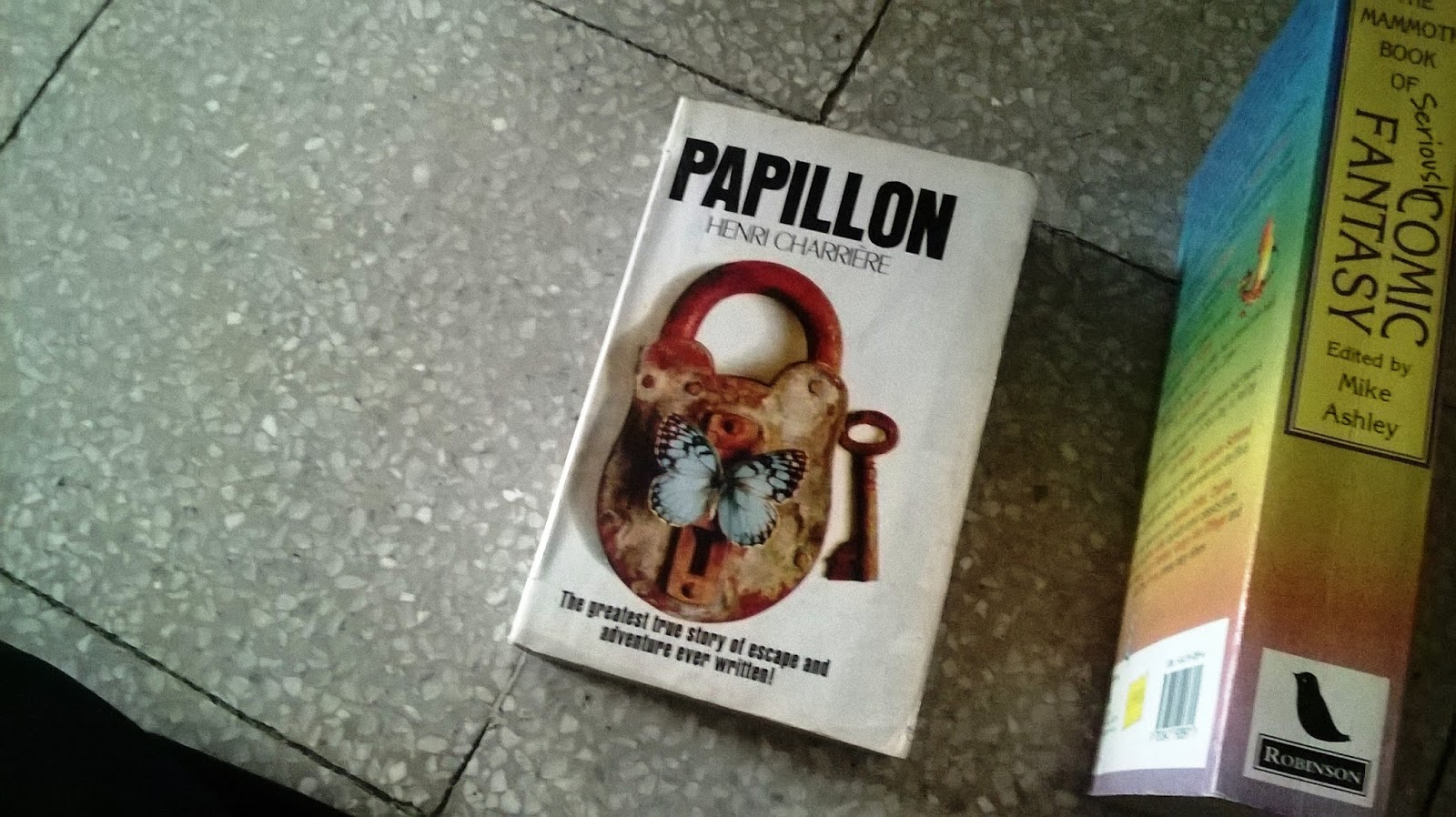
Papillon

The Godfather

Comic Fantasy

Gone With the Wind

One Flew Over Cuckoo's Nest

Schindler's Ark

The Haj

Thursday, December 10, 2015

Anomalisa

Charlie Kaufman’s return to directing seven years after Synecdoche, New York is, it turns out, significant. It gives Kickstarter, which is how it was funded, and the 2015 Telluride film festival, where it has premiered, their first real masterpieces. It innovates with stop-motion in ways your brain struggles to compute. Kaufman and co-director Duke Johnson offer images so moving and yet also so filthy Anomalisa might just make the first R-rated best animation Oscar winner.

And it addresses in new and fruitful ways the kinds of questions cinema sometimes aspires to answer. What does love look like? How does it feel to be deeply disconnected from the rest of the race? And, to quote its hero: “What is it to be human? To ache?”

That hero is Michael Stone, a famous-in-his-field inspirational speaker who has written a bestseller on customer service and is making a one-night business trip to Cincinnati from Los Angeles. He lands at the airport, goes to the hotel, orders room service and has encounters with various women – including an emotional ex called Donna, and Lisa, a charming telesales agent – before he delivers his keynote speech.

Michael is voiced by David Thewlis, retaining his Lancashire accent (and nailing his best part since Naked), Lisa by Jennifer Jason Leigh and everyone else by Tom Noonan. Noonan has a calm, normal voice, unmoderated whether he’s Michael’s wife, his son, the bar staff, the ex, a cabbie or a sex shop worker.

And not only does everyone save Michael and Lisa sound the same, they look the same, too. Only the hairstyle or gender (or species) switch as the smooth, gormless faces remain constant. These are humanised crash test dummies: each head divided into a number of plates - for ease of manipulation, presumably, but also to heighten the sense of uncanny construct.

Michael and Lisa, on the other hand, are more photorealistic. He has sunken eyes, stubble, a thousand-yard-stare, a face you forget isn’t flesh. She has a facial burn and a garrulousness shaped by shyness. They have bodies too: appallingly, amazingly realistic torso-thickened frames which tense and shudder like the real deal, and which we see naked in one extraordinary sequence that helped land the movie that rating (for “strong sexual content, graphic nudity and language”). But the real coup here is not Team America-style puppet porn: it’s that a scene which starts out earning gasps and laughs turns so touching, even erotic.

More here/

Moi Kohimare Adhunika Dalimi


This song, Moi Kohimare Adhunika Dalimi, By Bhupen Hazarika and Runumi Thakur, because I was in Kohima recently…

The English translations of the lyric for those who do not understand the language:

/I am the modern Dalimi from Kohima

/I am Gadapani from the modern plains

//Tonight, we are the companions
On a night train towards Guwahati

/Perhaps you are recalling often
The days of childhood in Jakhama village
Wearing red and blue wings like butterflies
Those dances of so many sweet festivals

/I am not terrified of the foreign land
Because you are so close to me
But reaching Guwahati do not forget
The affections of my Naga Hills

/Do you remember the bomb blast
In Lumding-Diphu a few years ago

/Against that backdrop of so much tragedy
Was the sweet introduction of our hearts

/Today I am the new daughter-in-law of Assam

/I am the son-in-law of Tuensang

//We are the blazing symbols
Of the unity from the East

/That Dalimi of Lakshinath is now lost

/I too am not Gadadhar of the yore

//Yet, today this togetherness of ours
Reminds us of the past still alive

/
Since the day the first Ahom king Sukapha descended the Patkai Hills and travelled to the plains, there has been an uneasy existence between the Assamese and Naga people. Much has been shared, including the language and the food habits. Yet, the unease remains, resulting into violence more often than not. Artists from the plains have often tried to find a solution to this. While writing the screen story for the first Assamese film ‘Joymoti’, Lakshinath Bezbaruah introduced the character of Dalimi, a happy-go-lucky Naga girl, who falls in love with the exiled prince Gadapani, hiding in the hills. This Bhupen Hazarika song, written in 1970s, takes a leaf from this reference.