Pages

Saturday, November 27, 2010

The Tamarind Seed

What comes to your mind when you think of Julie Andrews and Blake Edwards together. Victor/Victoria of course. And 10 (Apart from the fact that they were married to each other). In that sense, The Tamarind Seed (1974), starring Julie Andrews and Omar Sharif and directed by Blake Edwards is a lost cause. You may have never heard of the film. I never did until I picked up a copy at the local library.

First, the film is not for those Julie Andrews fans who like her as Marry Poppins or Sister Maria. Here, she hardly smiles, forget singing and dancing (And what a great smile she has!).

When the film opens, we meet her in the Bahamas, walking alone in the beach, thinking of her dead husband and the very-much-alive lover who has dumped her. One morning, a dashing, moustached Russian gentleman (Omar Sharif) hits on her. She resists a bit and then gives in; they are not going to sleep together, what’s the harm going sight-seeing together. Here we go. Sit tight for a romantic drama.

Hard luck, as we are forced to return to London, where Judith is a secretary to a very important man, and Paris, where Fedeor is a Russian spy. And we are in the middle of a cold, cold war.

For someone who was an infant during the cold war period, it’s very hard to get involved with the politics — the comrades and their ideology, and the British patriots and the British traitors, and so on.

In between are these two people. The Russians think, she is trying to steal information from him. The British think he is trying to convert her to the Ideology. And these two people, they are not even sure they love each other; he is anyways married, and they haven’t slept together as yet.

And when they finally sleep together, you really don’t care.

The title derives from a museum entry in the Bahamas, where on display is a tamarind seed, which looks like a man’s face — a slave who was wrongfully convicted as thief and was hanged on a tamarind tree, the same tree which bore the fruit. Intriguing. But what does it mean?

Friday, November 26, 2010

Kick-Ass

Directed by: Matthew Vaughn
Produced by: Matthew Vaughn; Brad Pitt; Kris Thykier; Adam Bohling; Tarquin Pack; David Reid
Screenplay by: Matthew Vaughn; Jane Goldman
Based on Kick-Ass by Mark Millar; John Romita, Jr.
Starring: Aaron Johnson; Christopher Mintz-Plasse; Chloë Grace Moretz;
Nicolas Cage; Mark Strong
Music by: John Murphy; Henry Pryce Jackman; Marius de Vries; Ilan Eshkeri
Cinematography: Ben Davis
Editing by: Pietro Scalia; Jon Harris; Eddie Hamilton
Studio: Marv Films; Plan B Entertainment
Release date(s): 26 March 2010 (UK)
Running time 117 minutes
Country United Kingdom; United States


Among the film critics I have read, like and frequently consult to, Roger Ebert tops the list. I discovered him little late, after reading more literary, cerebral film critics. Therefore, perhaps, there is an admiration for what has been doing to popularise good cinema for decades, and for his lucid prose, and how he can combine all elements of a film in a nutshell in his 700-word review.

I always consult Ebert after seeing a film. At most times we agree. Sometimes we don’t. Even when I don’t agree with him, his review reads convincing enough for me.

What I like most about the person is that he can take criticism with a pinch of salt. In the recent years, there has been anti-Ebert school of film criticism, claiming that Ebert’s reviews are too generic, the reviewer goes for the emotion than the art of filmmaking, and most importantly, his writing is shallow. These criticisms are proffered by more cerebral American film critics like Armond White and A O Scott. At one level, the criticisms are valid; Ebert is all these. But, what’s wrong with that, if you can connect to more people, if you can spread the love of movies to others? Despite everything, you cannot doubt Ebert’s passion for moving. Watching films for decades and still sustaining the passion, and writing about it, is a big deal. That’s the reason I admire the man.

Every year, Ebert kicks the hornet’s nest by offering a verdict about a movie that goes against the grain. Sometimes he offends the fanboys, and sometimes, the cerebral critics. If nothing else, it shows his influence in the field of American film criticism. Last year, he made enemies with the fanboys when he penned The Transformers: Revenge of the Fallen (Which was however a right reaction, the film was indeed trashy.), and made enemies with the cerebral-types when he chose Knowing as one of the year’s ten best. (Which even I found hard to agree with, despite the fact that I loved the Nick Cage end-of-the-world saga.).

This year, the same plot is being repeated with Kick-Ass, which he gave one star, even saying aloud that he would be flayed for his review; but couldn’t care less; he would not support a film that not only project violence by minors, but also reeks of bad taste.

After the review was out, the internet was rife with comments, mostly opposed the review, not just the fanboys, even the cerebrals. Peter Bradshaw of The Guardian gave the film four star, for example.

I saw the film very late, after reading several counter-reviews, aware that there is nothing much to look forward to in the film. I was right. Kick-Ass is just another film, there’s nothing extraordinary, and even the action sequences, criticised for its visceral goriness, are not so visceral, if you have seen any of the films by Takashi Miike, for example, or better still, Kill Bill. You known what I mean.

In a way, Kick-Ass is fun, though I would still prefer Scott Pilgrim, or for that matter, Sin City — the ultimate comic book-to-film masterpiece. Sin City sort of paved the way that adaptation of comic book to films need not be realistic. 300 took it to the level of hyper-realism. A while later, several filmmakers toyed with various other ways, all in adapting the works of Alan Moore — From Hell, League of Extraordinary Gentlemen, V for Vandetta, Watchmen. The results were varyingly satisfactory.

Come 2010, and comic book adaptation goes ‘meta’. I quote the word meta, since there is no one way to describe it. Let me try. Cinema as a medium of artistic expression demands a certain level of realism which is inherent to cinema only (the moving picture with sound.). In comic book, you imagine the moving picture, and freeze the most dramatic frame to give the reader/audience the feel of what’s happening. In cinema, the same thing may take five seconds, and 75 frames, several angles, and so on. Now, how do you marry the two mediums, especially when you want to retain the comic book feel in the film?

The key is to do something which is neither comic book nor conventional movie. (There have been various attempts, of different kinds. Some random examples, A Scanner Darkly, The Polar Express, Wanted.)

Whereas all the earlier examples I have mentioned tried to achieve this artistic integrity seriously, the recent ones, Scott Pilgrim, and especially Kick-Ass does it as parody. Now, this is in the structure of parody to exaggerate reality.

This is the reason why Kick-Ass is filled with pop culture reference (The alt-Olivia of the Fringe series on TV can use this film to learn more about our world.) It also tries to break the proverbial fourth wall, a little bit forcefully. (When Dave/Kick-Ass is being beaten up, he asks the audience, do you think I will be alive? Haven’t you seen American Beauty?) All these gimmicks in the film are supposed to be jokes, nothing more.

The plot involves a regular school kid, a comic book freak, asking a simple question, when so many people want to be Paris Hilton, why nobody wants to be a superhero, say Spiderman, or Batman — and one day, he decides to be a superhero. He buys a wet-suit costume and devise a name for himself — Kick-Ass. But the consequences are more than he could ever imagine.

So far the plot was okay. Even Ebert agrees. After that, I think, the film, fell in the trap of the blockbuster formula. The film which wanted to be a parody, started to take itself very, very seriously (There’s are touching father-daughter, father-son sequences, and so on.).

What do you expect when the parody tries to become as ‘good’ as the object it is parodying?

I shouldn’t waste time on the plot, there’s Wikipedia for that:
Roger Ebert also give an idea about the plot:
So does Vadim Rizov on Salon:
A hilarious, very violent black comedy puts a new twist on superheroics, says Peter Bradshaw:

Tuesday, November 23, 2010

Shanghai

Directed by: Mikael Håfström
Produced by: Mike Medavoy; Barry Mendel; Jake Myers
Written by Hossein Amini
Starring: John Cusack; Gong Li; Chow Yun-fat; Jeffrey Dean Morgan; David Morse; Ken Watanabe
Music: by Klaus Badelt
Cinematography: Benoît Delhomme
Studio: Phoenix Pictures; Barry Mendel
Distributed by: The Weinstein Company
Release date(s) June 10, 2010 (Shanghai)
Country: United States
Language: Mandarin/English


Dubbing is a big business in film industry. Sometimes, it’s reasonable as well. Mani Ratnam’s Roja won nation-wide accolades after the Tamil film was dubbed into Hindi. That’s how a lot of people saw The Jurassic Park when it was realsed in India in Hindi. Post- The Jurassic Park, releasing Hollywood movies in Hindi and other south Indian laguages like Tamil, Telugu and Malayalam has become a norm. Hollywood films are always dubbed in European languages.

There are severeal pluses in the scenario. It widens the market for the film for those who do not know the language of its origin, especially, for those who cannot even read subtitles in English. Rajnikant’s latest blockbuster Robot was dubbed from Tamil to Hindi, and it’s, well, a blockbuster.

On the minuses, dubbing breaks the myth of a film as a constructed reality. How do yo react when a Chinese farmer starts speaking in Queen’s English, or Tom Cruise in Malayalam. At best, it can alienate the audience from the screen story. There are also problems inherent with translation; there are so many expression in a source language that may not lend itself to an equivalent alternative in the target language. For example, I remember a certain film, in English, the character says, ‘shit’, and it’s translated to Hindi as ‘he bagawan’, for ‘shit’ as a cuss word does not have a Hindi equivalent.

Hence, I prefer subtitles, as subtitles does not alter the actual film in any way; it’s only an add-on to help us understand the narrative.

That’s one of the reasons why I could never sit through Bertolucci’s The Last Emperor and Scorsese’s Kundun. Both are great films, but the language used in these films break that ‘willing suspension of disbelieve’. I can understand the emperor talking to the Peter O’Toole character in English, but when he speaks to the royal guard in English, that’s too much. Let them speak in the language they are supposed to and give us subtitles. The same is the case with Kundun; I could not come in terms with the fact that those poor villagers in rural Ladakh speak impeccable English, even if with an accent.

It’s all the more difficult to withstand when an American character starts speaking in Mandarin, as happens in case of the John Cusack charater in the film Shanghai. It’s utterly disorienting.

Shanghai, directed by Mikael Håfström, is a Hollywood, Thai and Chinese co-production. The English version has been released at certain centres, including India, but not in US so far. The copy of the film I saw was the Chinese version. The film also stars Gong Li, Chow Yun-fat, and Ken Watanabe. Watanabe was the reason, I wanted to see the film. But to see Cusack sprouting Mandarin was surreal.

The film itself is not bad, if not great. It’s a classic film noir, so much so that you can spot the instances which make it a noir film — including Gong Li as the femme fatale (she makes a brilliant femme fatale; I remember her in Farewell My Concubine, and how I hated her in that film, she was that good.)

The scene is, as you may have guessed already, Shanghai, a few days before the Japanese bombing in Pearl Harbour. Here, the inspiration is, The Third Man, where the city, the only place in China still unoccupied by the Japanese, has been divided into different blocks. There are underground resistance groups, there are spies, counter-spies, opium dens, dazzling casinos, ball dances, mysterious men in fedoras, dark rain-soaked evenings in deserted alleys, shoot-outs at public places, crimes of the past, and most impartially, dead body of an American. Enters the Cusack character to investigate the murder of his friend, who was having an affair with the mistress of the powerful Japanese Captain Tanaka. And so on and so forth.

In short, there’s is nothing here you haven’t seen before, except, John Cusack speaking in Mandarin in the copy I saw.

Sunday, November 21, 2010

Danzel Washington

I don’t remember the first Danzel Washington movie I have seen. Perhaps it was Crimson Tide. It was a big film in 1995. Before that I had read about him, regarding his work in Malcolm X. I fell in love with him in Philadelphia. He was so gorgeous, so smart, so sure of himself, and with such empathy. I found him to be the most handsome man I have ever seen. I still think he is one of the most handsome men I have ever seen.

In the recent years, there have been a lot of African American actors finding mainstream success, Will Smith, for example, or Jamie Foxx. But, I think, after Sidney Poitier, Danzel Washington is the only African-American actor who represents not only an individuality, but also a sense of community. He is the representative of his race. He is the proud flagbearer of his community.

If you look at this career, every role he plays has a purpose, and every role he plays lays bare the politics of race in America some way or other, overtly in films like Glory, Malcolm X, and covertly in, well almost all his picture. Some of his movies may not be up to the mark, like Déjà Vu, but not a single picture he stars in is flippant. He has always stared in films which are either thrillers or biopics. If you consider this, almost half of his films are biopics, or films inspired by real events. Even his directorial ventures, Antowne Fisher and The Great Debeters, are inspired by real event.

This speaks volumes about the integrity of the man.

Danzel Washington Filmography:

1981 Carbon Copy
1984 Soldier's Story, A
1987 Cry Freedom
1989 Mighty Quinn
1989 For Queen and Country
1989 Glory
1990 Heart Condition
1990 Mo' Better Blues
1991 Ricochet
1992 Mississippi Masala
1992 Malcolm X
1993 Much Ado About Nothing
1993 Pelican Brief
1993 Philadelphia
1995 Crimson Tide
1995 Virtuosity
1995 Devil in a Blue Dress
1996 Courage Under Fire
1996 Preacher's Wife
1998 Fallen
1998 He Got Game
1998 Siege
1999 Bone Collector, The
1999 Hurricane
2000 Remember the Titans
2000 Loretta Claiborne Story
2001 Training Day
2002 John Q
2002 Antwone Fisher
2003 Out of Time
2004 Man on Fire
2004 Manchurian Candidate
2006 Inside Man
2006 Déjà Vu
2007 American Gangster
2007 Great Debaters, The
2009 Taking of Pelham 123, The
2010 Book of Eli, The
2010 Unstoppable
2012 The Matarese Circle

The Sorcerer's Apprentice

Directed by: Jon Turteltaub
Produced by: Jerry Bruckheimer
Screenplay by: Matt Lopez; Lawrence Konner; Mark Rosenthal; Johann Wolfgang von Goethe (poem)
Story by: Doug Miro; Carlo Bernard; Matt Lopez
Starring: Nicolas Cage; Jay Baruchel; Alfred Molina; Monica Bellucci; Teresa Palmer
Music by: Trevor Rabin
Cinematography: Bojan Bazelli
Editing by: William Goldenberg
Release date: July 14, 2010
Running time: 111 minutes
Country: United States
Language: English


The first Nicolas Cage film I saw was Face/Off, and I had fallen in love with him. He looked so handsome. Nowadays, however, he has become a little tiresome; he seems to be everywhere so much so that you can no longer call a picture he is in a Nick Cage picture. This year so far, he is in Kick-Ass and in The Sorcerer’s Apprentice. If you insist on comparing, I would give more marks to Kick-Ass, which is fun in a vicarious sort of way, and he is not there full-time; (spoiler) he dies before the film is over. More of that later.

Coming to The Sorcerer’s Apprentice, the film is so lame and unoriginal that it makes films like Percy Jackson and the Olympians a masterpiece and Harry Potter series work of a genius, and it is not saying much. There is nothing hold on to in the film, absolutely nothing, as Roger Ebert says, it’s all sugar and caffeine, no protein.

The film stars Jay Baruchel as Dave Stutler, a New York physics students, who does nothing but chase the girl of his dream, until he finds out that he must learn magic from the great Balthazar to save the world, as usual. You may remember him as Tal from Nick and Norah’s Infinite Playlist which starred Michael Cera. Agreed, Cera is not also a hero material, but he has certain goofy charm, which Baruchel also tries to project, but to no avail since the script is so dull. If you come to learn that you are a magician, no less receiver of the legendary Merlin’s inheritance, and how would you react? Duh. So, it’s between Nick Cage and Alfred Molina to fight it out. Whatever.

And, frankly, I have developed a great hatred for films where all actions take place in New York City, why, pray, aren’t there other place in the US, like Maine, or any other city?

Saturday, November 20, 2010

Scott Pilgrim vs the World

Directed by: Edgar Wright
Produced by: Edgar Wright; Marc Platt; Eric Gitter; Nira Park
Screenplay by Edgar Wright; Michael Bacall; Based on Scott Pilgrim by Bryan Lee O'Malley
Narrated by: Bill Hader
Starring: Michael Cera; Mary Elizabeth Winstead; Kieran Culkin; Ellen Wong; Alison Pill; Mark Webber; Johnny Simmons; Anna Kendrick; Jason Schwartzman
Music by: Nigel Godrich
Cinematography by: Bill Pope
Release date: August 13, 2010 (US)
Running time 112 minutes
Country: United States
Language: English


Scott Pilgrim vs the World is fun. Pure fun, from start to finish. It took me to the days when I was in school, or just joined college. Those were the days. No care for the grown-up world, yet doing a lot of stuff, which today I may find useless, but those days they were matters of life and death. Not that my adolescence was anything like Scott Pilgrim — casing music and girls. But the high adrenaline rush of constant action about nothing was almost the same.

Scott Pilgrim vs the World is a odd film, and it catches you unawares. It has a regular plot, teen-age love story. Scott Pilgrim (Michael Cera) is a 22-year-old Toronto brass guitarist with a band called Sex Bob-omb, who is dating a highschooler, till he sees a Burgundy-haired American, Romona Flowers. He pursues Romona, and finds that to date her, he will have to defeat her seven evil exes who control her love life. Okay.

But the tone of the film, and how it is presented, with a sense of breathlessness and with a visual flair borrowed from the aesthetics of comic books and video games, sets it apart from the run-of-the-mill stuff, and whatever. The film is neither real, or a pure fantasy; it creates a world where both the worlds collides. The setting indeed looks Toronto, but how Scott has showdowns with the exes, it’s purely a video game world where after he defeats each ex, he earns points, and coins start falling from the start. But, how a nerd like Scott could master all those Kung-Fu like moves? No answers.

Based on the graphic novel series Scott Pilgrim by Bryan Lee O'Malley, the film retains its graphic novel feel, not in a way Sin City, or 300 did, but in a more ‘pop’ way, by heightening the feel, but not at all trying to make it real, and at the same time not make it exaggerated.

But director Edgar Wright fills the screen with so much action that you have no time to bother about such silly questions. One thing that the film gets right to the tee is the language the characters speak, with lots of duh, cool, whatever and so on.

After Superbad, Juno, Nick and Norah’s Infinite Playlist, Michael Cera has carved a niche for himself in nerdy comedies. He is not the traditional hero material, but he is smart and has a certain charm. Yet, it’s difficult to imagine him as action hero. But, in Scott Pilgrim, the actions are presented in such video game variety that you are too baffled and too engrossed to ask questions. It’s never real, ever after Scott is beaten to pulp, it’s not visible on his face, forget blood and bruises, even his clothes are intact.

This is a film for those who dreams in comic book, video game aesthetics, whatever that means.

When it comes to action-comedy, director Wright knows his job; examples Hot Fuzz and Shaun of the Dead. One good thing about his is that he does not take himself or his material seriously, and have a blast in whatever he is doing. That’s the endearing quality of Scott Pilgrim. The film shines of technical brilliance, especially in action — the background is constantly on the move, the characters are constantly on the move, they start a sentence at one place and end it somewhere else, and there’s all those dialogue balloons appearing on the screen, the onomatopoeic noises like boom, bang. For example, when his when his Chinese girlfriend utters the word love, a big ‘LOVE’ in pink foam hit Scott and he has to wave his hand to get rid of it. Then there are those video game tricks, like earning points after each win, and there is also a voice-over to offer a different perspective to the plot point.

Scott Pilgrim vs the World is a joyride.

Thursday, November 18, 2010

Inside Man

Directed by: Spike Lee
Produced by: Brian Grazer
Written by: Russell Gewirtz
Starring: Denzel Washington; Clive Owen; Willem Dafoe; Chiwetel Ejiofor; Jodie Foster; Christopher Plummer
Music by: Terence Blanchard
Cinematography: Matthew Libatique
Release date(s): March 23, 2006
Running time 129 minutes
Language English


Being an admirer of Spike Lee and a huge fan of Danzel Washington, it’s a surprise that I never came around to see ‘Inside Man’ when it was released in 2006. Blame it on the reviews. The reviews I chanced upon called it a disappointment, and I did want to spend time on a disappointed Danzel fare. It was that time before I came to the realisation that a disappointing Spike Lee film can be better than those box office blockbusters.

I did catch the start of the film in a TV channel though, some years ago, and was struck by its soundtrack — a vehicle is driving through New York city and the soundtrack plays ‘Chaiyya Chaiyya,’ from Mani Ratnam’s ‘Dil Se’. Now, this is one of my favourite Hindi songs (you remember the picturisation, Shah Rukh Khan atop a moving train, in a red jacket, gyrating with sultry Malaika Arora). I should like the film just for using the song (which also appears in the end credits.).

I liked the film, and yes, the film is disappointing, in a way. It’s not a simple bank heist film, as the plot point suggests; like all Lee films, there are so many things going on at the same time, commentary on culture, racism, capitalism, video game, violence, love, the Albanian president, Sikh immigrants in New York, post 26/11 and what not. But, at the end, everything does not come to fruition, at least not in a way we expect them, that’s the disappointing part.

The major problem with the film is the premises on which it is based. A certain Mr Case worked with the Nazis during WWII, for which he received a large sum. He took the money and started a bank. Later, he felt guilty about what he had done, and has been trying to atone for it since. But why did not he destroy the evidence that could incriminate him, instead of keeping it in his bank since 1948? And, if there was no witness to his war crimes, how the robber mastermind, Dalton Russell, played by Clive Owen, knows about it till the last detail? And how, pray, Mr Case (Christopher Plummer), who worked with the Nazis, is still alive and kicking, in perfect good health? No answers to all that.

And then, between the heist and the hostage situation, between Russell and Detective Keith Fazier, with a Z, there appears a mystery woman, Miss White (the ever smart Jodie Foster). But who is she, and how she wields such powers? What about her own motives?

You trust Lee to bend a traditional heist-hostage film. You don’t expect him to do the run-on-the-mill stuff. For example, through the hostage situation unfolds like any other film, it ends in an ingenuous way. And very smart indeed. Nobody gets hurt, nobody dies, and everybody is happy, everything is good in the world, as Miss White says. But the film does end here. It then turns its energy to a Cartier diamond and the skills of Detective Frazier, and the crimes of Mr Case — the film has entirely been his case, after all.

And wait, the film still does not end. After all, our good detective Frazier must get married and he must have a diamond for his bride.

The film suffers from a paradox — over-explanation and over-mystery. There are things that are explained beyond necessary. At the heat of the hostage situation, we see the detectives interviewing the hostages, so we know everything went well. But, there are so many things that are not explained at all, like the real motive to Russell. So when he says, “Respect is the real currency,” in the end, it sounds a little corny.

Nonetheless, as I said earlier, a bad Spike Lee movie is better than your average summer blockbuster — there are so many things going on, like Russell giving a lecture against the violence in video games, like Frazier teaching a white cop when to say African American, like the Sikh bank employee complaining about the treatment meted out to him (he is suspected a terrorist because he is wearing a turban.). And the actors are first rate — Danzel Washington has mastered the role of a black man in a white situation, in nearly all his movies, yet he is always powerful, always articulate, always robust. Clive Owen though does not get much chances, what with half the time he is forced to cover his face in a musk. He’s a terrific actor, nevertheless.

Lachit Barphukan

[I wrote his piece on Lachit Barphukan, in 2003, for a friend who wanted to it for some project or something. I recently retrieved the file from an old CD. I tried to rewrite it, but realised that the piece is so badly written that, it's beyond my powers to do anything about it]

A contemporary to Aurangazeb and Chhatrapati Shivaji, Lachit Barphukan’s claim to fame does not lie in the military glory of Shivaji or in the political masterminding of Aurangazeb. Lachit is more of a symbol of uncompromising patriotism in Asom. History is almost silent about him, except for a brief mention in the context of the war of Saraighat. Thus, we know that there really existed a man called Lachit Barphukan who was a General and the governor of the lower part of Asom, signified by his title Barphukan.

Those days titles were not hereditary. It was given to a person according to his abilities. The majority of surnames that we find among Asomiya people now are the derivations of the original titles conferred to people by the Ahom kings.

Ahom kingdom in Asom was established by King Sukafa, who declared himself king in the year 1228. From that day onwards Ahom ruled Asom till 1838. There was none at home to dispute the authority of the Ahoms. The neighboring tribal kingdoms were dominated by the Ahoms by the power of the sceptre, or by the power of friendship.

In the Ahom kingdom, geographically, Asom was divided into two parts, the Brahmaputra valley, Guwahati and its surrounding areas were called Lower Asom, as it is called today. Beyond this point stretching to the hills of Arunachal Pradesh was Upper Asom. The seat of the Ahom kings was Gadhgaon in Sibsagar district. It was impossible for a foreign army to invade the capital, for if you are coming from the mainland India, you have to cross Guwahati, and before Guwahati numerous rivers and indescribable rain forests. The very reason why Asom is/was accused of being a jungle country, a country of red rivers and blue hills. This is also the reason no outside force could attack Asom. When it happened, the reasons were personal quibbles at home when one commander, another Barphukan, left his country, met the Burmese kings of modern day Myanmar, and invited an army.

The ‘Maan’ people, as Burmese were known in Asom, created havoc and the reigning king had to seek help from the British stationed in Shrirampore in Bengal. British came, the treaty of Iandaboo was sealed and the independence of Asom was gone forever.

Back to Lachit, Aurangazeb is the Baadshah of Delhi, a strong military leader with a greedy dream to become the ruler of entire India, including Asom. He sends 18 military troupes to Asom only to taste failure. He is furious. He wants Asom into his authority at any cost. He sends one of his brightest officers Mir-Zumla, the Governor of Bengal, for one last time with a stern order, “Get me Asom or never return.”

Mir-Zumla is an expert of war. The advantage with him now is that he has all the possible information regarding the climate, people, land and local warfare. He can prepare himself well and this time nothing can stop him from winning.

This is the reign of Chakradhvaj Singh. He is a weak ruler given to pleasure and woman. He is a bad name to the Asom dynasty. But he is a king nonetheless. The lower Asom is governed by Lachit Barphukan. It is not many months since Lachit has campaigned against the Mughals and made them run away. The king is mightily happy with him. After the victory, everyone is taking time to share their sense of victory.

Seems Allah is in favour of Mir-Zumla at last. He faces no serious obstacles in the way and in three months time he almost reaches Guwahati. He has already occupied all the important forts of the lower Asom and Guwahati is within his reach.

When the news of the Mugals coming reaches Lachit, he is severely ill. The spy, who got the news, is surprised by the fact that no preparations has been done to stop the invading army. Lachit is confused. How can he arrange a big army overnight to fight with 12 thousand horses and thirty thousand foot soldiers of the Mughals? Soon the news reaches the king. He sends a massage to Lachit: “Give Guwahati to them and make a truce so that they leave from there.”

This massage angers Lachit. In return he sends a pair of women’s clothing, complete with bangles and all, and a letter asking the king to wear those if he is scared. Lachit writes, till there is the last breath on the last Asomiya soldier, they will not give Asom to the invaders. He asks the spy how the enemy is coming. The spy informs that they are coming by foot and is planning cross the Brahmaputra at Saraighat.

Instantly, Lachit orders his men, “To Saraighat. We are going to build a fort at Saraighat.” His juniors think that the fever has made Lachit delirious. How can you plan to build a fort in one day? Tomorrow, the enemy is reaching Saraighat. It would be wise idea to surrender Guwahati. But Lachit is adamant. He won’t listen to any counsel.

He gets up for his sick bed and marches to Saraighat with all the able-bodied men he could find in Guwahati. Soon men get busy in their job. Even his sickness does not stop him from inspection and encouraging his men.

Soon it’s midnight and the fort is not yet half ready. Lachit’s maternal uncle, who was also in the group, finally gathers some courage, encouraged by his fellow men and approaches Lachit, “The men are tired. It’s midnight. Can they take some rest?”

The whole idea of rest infuriates Lachit. He gets up from his bed, draws his sword and with a single stroke of the sword cut his maternal uncle into two pieces, saying, “Mama is not greater than the motherland.”

The shock and courage of this incident gives a new enthusiasm to Lachit’s men. They work with all their might and as the morning approaches, the fort is ready.

Mir-Zumla arrives and he is caught unaware. He was not expecting a surprise. And after a bloody war that lasted for the whole day he is defeated.
The dream of Aurangazeb remains a dream.

Till date, in Asom, Lachit is remembered for his brave act of killing is maternal uncle, and for his sense of duty and for his unprecedented patriotism.

Here’s the detail account of Lachit Barphukan's exploits >>>>>>

Monday, November 15, 2010

Please Give

Director: Nicole Holofcener
Writer: Nicole Holofcener
Stars: Catherine Keener, Oliver Platt and Rebecca Hall


Please Give (2010) is a very odd film indeed. It’s one of those films you won’t pay the admission price to see it in a multiplex, yet would happily sit in front of it when it plays on TV. It’s like reading a fantastic story on a random magazine you picked up at the station before boarding the train for a short trip. You are surprised how good it is.

It’s a New York film to the bones. The outdoor scenes will remind you of Sex and the City, the series, not the films. But it’s quite an antithesis. Unlike the fashion magazine look of SATC, the New York of ‘Please Give’ is about real lives, real people and real issue, which may not be life-changing, but complicated nonetheless.

Plotwise there’s no plot in ‘Please Give.’ It introduces us to a bunch of people, two families — two sisters and their grandmother, and the grandmother’s neighbours, the parents and a 15-year-old daughter Abby — and invites us to see their lives as their live it, and boy, is it interesting! Fact can be stranger than fiction.

The film understands New York and understands the human heart. Here lies the beauty of the film, and how it takes us through the array of scenes akin to comedy of manners.

The plot from Wikipedia: Kate (Catherine Keener) and Alex (Oliver Platt) are a couple living in a New York City apartment with their teenage daughter Abby (Sarah Steele). Kate and Alex own a furniture store specializing in used modern furniture, which they buy at estate sales. They have bought the apartment adjacent to theirs, but its occupant, the elderly and cranky Andra (Ann Guilbert), will stay in it until she dies. Andra has two granddaughters, the dutiful and generous Rebecca (Rebecca Hall), a breast cancer radiology technician, and the self-centered Mary (Amanda Peet), a cosmetologist. Kate is conflicted about the profits she makes from furniture sellers who do not know the value of what they are selling; by the contrast between homeless people in her neighborhood and her own comfortable life; and by the fact that her family will only be able to expand their apartment when Andra dies. She tries, unsuccessfully, to assuage her guilt through volunteer jobs (which leave her weeping) and donations to homeless individuals (which sometimes backfire).

What I like about the film is that it loves its characters so much that it lets them be. The film does not forces the characters to grow up, or change or find their destination, happiness. We don’t know if Rebecca will get married to her boyfriend, if Mary will get over her lover. Life goes on, and things does not change overnight. I also admire the screenwriter/ director for not falling into the temptation of following the beaten track. There is an extra-marital affair track in the middle of the film, which plays quite logically, and it could have been stretched to melodramatic effect. What if Abby comes home from the beauty parlour and tells her mother about her father visiting Mary. It would be a blow to already fragile Kate. I was dreading that this will happen eventually. But it did not. That’s because, the film loves Kate, and does not want her suffer more than she has already. And yes, what she feels for the homeless and about her own privilege status is real. But the film does not really try to understand her and find a solution, but lets her be. There is no resolution, and this is probably the best part of the film.

This is how we live. And we are not saints.

Friday, November 05, 2010

Kolatkar’s Jejuri, Now

Arun Kolatkar died on September 25, 2004. But the reclusive artist-poet is not dead. He will live as long as the name Jejuri remains on the map. Kolatkar achieved in a collection of 31 short poems, what every travel writer, every travel magazine/show aspires. He turned a small, provincial temple-town into a myth. In 1974, after the slim volume, titled ‘Jejuri’, was published by a small-time press Clearing House, the flow of Indian poetry in English took a sharp, unexpected turn, and a local deity of the Dhangar community in the state of Maharashtra became a legend. Such was the power of those 31 short poems.

You cannot enter the town of Jejuri without remembering Kolatkar. Much has changed in 2010. The population has grown, there’s more affluence than seen by Kolatkar:

When you hear her say,
‘What else can an old woman do
on hills as wretched as these?’

You look right at the sky.
Clear through the bullet holes
she has for her eyes. (An Old Woman)


There are more curio shops than you can count; feature of any temple town in India. There are more visitors. Khandoba, the deity to whom the temple is dedicated, is the ‘kuldevata’ of a number of communities in Maharashtra. Tradition demands that when a man gets married, the first thing he has to do is to visit the Khandoba temple in Jejuri. Tradition demands that on the way to the top of the hill where the temple is located, the groom must carry the bride; to signify that he’ll take care of his wife for the rest of his life. Now, that’s a difficult task indeed. There are total 450 steps till you reach the fort-like temple. Nowadays, most grooms take two or three steps carrying their wives, and if you want to preserve the precious memory, you have the local photographers who will click your picture and deliver you the prints in 20 minutes flat.

Yet, there’s something timeless about the place. A new century does not make much sense in Jejuri. Things sure look different than it was in Kolatkar’s time, yet some things remain the same. There are still the beggars, yes, and there are old women, selling flowers, leaves and turmeric powder and such; there are stray animals, dogs and goats, there are locals, desirous of your alms, and there’s the shrine of Yeshwant Rao:

Are you looking for a god?
I know a good one.
His name is Yeshwant Rao
and he’s one of the best.
look him up
when you are in Jejuri next.


He’s still there. So are the Muralis, the girls married off to the god, and the Vaghyas, the bard of Khandoba, and the faithful, all smeared in yellow, the colour of Malhari Martand. This is the peculiarity of the Khandoba temple, the yellow turmeric. In India, red, scarlet, the colour of sindoor, is the colour of the God, but not here. Here’s it’s yellow, the colour of the earth. Against the backdrop of the stone stairs and the stone fort in the middle of which stands the temple of Martanda Bhairava, the yellow of the turmeric and green of the Bel fruit-leaves offered to the God create a primal picture. Yes, somewhere time stopped on the top of the hills a long time ago.

You get down at Jejuri and look upwards, from anywhere, and you will notice the huge sign, where written in Marathi, in big, are the words: Jai Malhar. You follow the direction that will lead you to the endless stairs at the end of which awaits Lord Khandoba, and his horse. To give company, there are the damons he killed and Khandoba’s five wives, all turned into hillocks by the ‘kadak’ (fierce) God. From the fort that surrounds the temple, you can see the Jejuri village, now a town. You can also spot the site where stands the original temple, the Kadepathar. It’s a difficult climb, therefore, the current temple was constructed, which is known as Gad-kot.

Yet, none can evoke the impressions of Jejuri like Kolatkar did, in his wry, cynicism, which also betrayed a deep love and understanding of the people he met:

And as you look on,
the cracks that begin around her eyes
spread beyond her skin.

And the hills crack.
And the temples crack.
And the sky falls

With a plate-glass clatter
Around the shatterproof crone
who stands alone

And you are reduced
to so much small change
in her hand (An Old Woman.)


Biography of a God:
Khandoba, also known as Khanderao, Khanderaya, Malhari Martand and Mallu Khan is a regional Hindu deity, worshipped as Martanda Bhairava, a form of Shiva, mainly in the Deccan plateau of India. He is the most popular family deity in Maharashtra. He is also the patron deity of warrior, farming, herding as well as some Brahmin (priest) castes, the hunters and gatherers of the hills and forests. The cult of Khandoba has linkages with Vaishnava and Jain traditions, and also assimilates all communities irrespective of caste, including Muslims. Khandoba is sometimes identified with Mallanna of Andhra Pradesh and Mailara of Karnataka. The worship of Khandoba developed during the 9th and 10th centuries from a folk deity into a composite god possessing the attributes of Shiva, Bhairava, Surya and Karttikeya (Skanda). He is depicted either in the form of a Lingam, or as an image riding on a bull or a horse. The foremost centre of Khandoba worship is Jejuri in Maharashtra. The legends of Khandoba, found in the text Malhari Mahatmya and also narrated in folk songs, revolve around his victory over demons Mani-malla and his marriages. (From Wikipedia. More Here.)

'A Film By Jabbar Patel'

Jait Re Jait: A minor masterpiece

Jait Re Jait, the 1977 Jabbar Patel directed, Smita Patil-Mohan Agashe starrer is kind of an oddball film. The soundtrack by Hridaynath Mangeshkar was an instant hit, even before the days when audio cassettes democratised how you listen to music. Even today, every Marathi-speaking ‘literate man’ knows the songs — ‘Mi Raat Takli’, ‘Ami Thaakara, Thaakara...’ and my favourite ‘Tujha Rupacha Bashinde...’

And the film? I have asked a lot of Marathi-speaking people, who watch Marathi films (sometimes out of obligation, for example, at film festivals, sometimes out of love, for example, recent films like ‘Valu,’ ‘Natarang’...) and none have seen the film. Which is a pity actually, because ‘Jait Re Jait’ is an important film, perhaps not in the same league as ‘Umbatha’ or ‘Simhasan’ (or for that matter, ‘Dr Babasaheb Ambedkar’), it nonetheless is a minor gem from Jabbar Patel’s oeuvre. The film is important because it is rooted in the ethics of filmmaking of the time — the leftist movement, the parallel cinema, neo-realism (even though at time all these are obscured by the incessant songs, the ‘anthropologist’s eye’ that Patel masters in the film is unmistakable). Today, you cannot even imagine making a film like this, a film located at the heart of community — the Thakars — and told from the inside point of view. There is no clash of cultures, there is no pressure of ‘civilisation’ as most movies about indigenous communities tend to do. Instead, it’s a loving, tender look at the community and its life, and the rituals. The director seems so much immersed into the lives of the community that at times, the film turns into a documentary, with the camera gawking at the action from a distant, without a comment, without a judgement. This is one of the many triumphs of ‘Jait Re Jait,’ (which literally mean ‘win, win’) and this is why it is one of my favourite Marathi films, despite the fact that I did not like how the film ended, and how the second half of the film dragged at stretches.

I call Jabbar Patel Maharashtra’s (can we make it India’s) Martin Scorsese. Like the American auteur, Patel also spreads a love of cinema which is infectious and inspiring. He was one of the important figures of the Marathi experimental theatre movement, along with people like Mohan Agashe, Satish Alekar and others, who championed Vijay Tendulkar, and established the uniqueness of modern Marathi stage, away from the ‘classic-ness’ of sangeet nataks, and going to the roots of the folk tradition.

Likewise, his forays into cinema was unique, and revolutionary for the time. When other filmmakers were busy doing cinema as entertainment, with comedy and melodrama as presiding deities (Dada Kondke’s name comes to mind, and his place in Marathi cinema is indisputable), Patel took the route of social criticism. He brought the parallel cinema movement of the 1970s to Marathi cinema with political and socially relevant films like Samna (1974), Simhasan (1980), Umbartha (1982) and others.

And his contribution to film movement will need another post to discuss. Suffice to say that he has been successfully running the Pune International Film Festival for nine years now, and it’s not a mean feat.

Yet, ‘Jait Re Jait’ is something else, it’s may be socially-relevant, it’s never political. Even the social relevance is not examined in depth. There is only one outside character in the entire film, a Brahmin, whom the protagonist Nagya asks, how to become a ‘Punyawant’, the pure one. And the Brahmin scoffs on him saying that someone who eat meat can never be pure. And that’s it.

Otherwise, the film is resolutely focused on a small community, the Thakars, who call themselves the birds of the forest (‘ya rana chi pakhar’). It’s mostly a hunting-gathering society, who subsists on selling firewood in the nearby market, which we never see in the film. They also do some farming. They believe in the spirit of the forest, and a deity, a version of Lord Shiva, called Lingoba, whose temple is on the top of the hill. And, music, the drum, the songs and the dances play an important role in their lives. That’s why the film has more songs than the dialogues.

Among them is Nagya, the village bhagat’s son. A bhagat is sort of a religious head, but not quite a bhahmin. One day while he was still young, Nagya is chased by a herd of bees. When he complained to his father, like all fathers, he tells Nagya a story, the story of Lingoba, and how the bees protect the deity, and how the queen bee is the most beautiful among them all. How can I see the queen bee? Nagya asks. You cannot see the queen bee, he father tells him, only the ‘pure one’ can see her. Nagya grows up to be handsome Mohan Agashe, with a single-minded obsession. He wants to see the queen bee. “Mala punyawant hoyase (I want to be pure), he tells his father, I want to see the queen bee. His father tries to distract him, but to no avail. Appears Chindhi, a village girl, who has run away from her husband because he is ‘useless.’ She sees Nagya and instantly falls in love. But they cannot get married unless she returns the bride price; which she does and they marry after a lot of trial (With Nagya losing a eye.). But his obsession won’t leave him. He must climb the lingoba hills, he must see the queen bee. This time he has support in Chindhi. They go all out in their quest; but to what end?

It’s a tragic story of obsession, and a desire to understand what is probably beyond understanding. Chindhi is more practical. Her desire for Nagya has a goal, and after much hardship she achieves it, but for Nagya, his desires are destructive from the very beginning.

The story is told in the form of a traditional play, with two ‘sutradhar’ narrating the story and taking forward the action. Like the ‘sutradhar’ of the classic Sanskrit plays, they also take part in the action, mostly to sing — so we have songs, and songs, and frankly, we are not complaining. If Hridaynath Mangeshkar did nothing else other than the songs of ‘Jait Re Jait,’ he would still be considered one of greatest music composers of India. He is extraordinary.

But what pays for the film, despite all its flaws (and there are flows, starting with Mohan Agashe’s wooden acting; other actors are brilliant though, especially Smita Patil), is the love with which the film is constructed. When a filmmaker goes to the jungle to make a film on the tribes, there are chances of voyeurism creeping in; there are always chances of the director telling us how ‘we’ are better than ‘them’, and see ‘their’ customs and tradition with the curiosity of a kid going to the zoo. Patel’s camera also observes the customs and traditions of the community, but not as a voyeur, but as someone for the inside. And this, by no means easy task. Look at the actors in their consumes, which is actually bare minimum by today’s standards, and how they own it. They become the characters.

And, finally, the film contains the most erotically-charged song and dance routine I have seen in Indian cinema, especially when the erotic gaze is directed at a man. Nagya, with a red head-gear and a garland of flower beats the drum passionately. The sutradhar sings: Gorya dehat barati kanti / Nagini chi kata / Are zhalo ami taybi....

Such beauty in the fair body, as if the snake’s skin
We all went mad when we saw the sight in the night...


It goes on and on... (‘When your body is made of coral who needs any other jewel’), and Chindhi looks at Nagya, and the camera regards him with as much passion as the lenses can manage. It’s a beautiful piece of art. (If you see the film, look out for the reference to snake imagery, there are abundance of it, and it’s very interesting.)

In an unrelated note, there’s another similarity between Patel and Scorsese: Making documentary on musicians. While Scorsese has done several like ‘No Direction Home: Bob Dylan’ and the Rolling Stones saga ‘Shine a Light’, Patel has directed a documentary on Pandit Shivkumar Sharma.

View: Mi Raat Takli on You Tube

Wednesday, November 03, 2010

‘A Film By Guillermo Del Toro’

Being a Guillermo Del Toro fan, I sought out ‘Cronos’, his debut film; it’s a vampire tale unlike any other, and very disturbing, even by Del Toro standards. That because Del Toro places a young girl in the middle of the ‘bloody’ action, a girl who does not utter a single word till the last scene, but regards everything with child-like curiosity, and terror. It was traumatic.

I admire Del Toro, if nothing, for the simple fact that he is brimming with ideas, which are original, iconoclastic, and not necessarily pretty. In other words, you can say Del Toro is the true protégé of Luis Buñuel. Buñuel’s surrealism did not know bounds, so is Del Toro’s. But there’s a difference. While Buñuel’s dreams were rooted in the real world, despite his day-dream visionary-satirical images, Del Toro seeks out the imaginary world of magical creatures. And his magical creatures are so original that they create a genre of its own (for example, Hellboy and his friends, the faun and the fairies in Pan’s Labyrinth.) That the reason why I was one of those people waiting for the release of JRR Tolkien’s The Hobbit. He had the best original mind to bring Bilbo Baggins and his friends to big screen. But that was not to be so. Last reported, Del Toro had left the project, which will now be directed by The Lord of the Rings director Peter Jackson.

The world of fairy tales, since the times of Hans Christian Andersen had been world of wonder, and a fearsome world. Danger lurks beneath each magic trick. When Disney took over the business of fairy tales in 20th century, the fear factor was purged completely, and the fairy tale world become a haven for children.

Del Toro refuses to follow this model. Unlike the traditional fairy tale universe, where all magical creatures look fantastic and beautiful, Del Toro creates worlds where magical being are ugly, mean and complex like their human counterparts. That’s the allure of Del Toro’s movie universe.

Cronos (1993), his directorial debut, is a vampire tale, minus the vampire himself. Like all vampire movies, Cronos too involves a choice. However, the way Del Toro lays out the action, defies the traditional vampire fiction model. Here, our protagonist, an old antique dealer, Jesús Gris, turns vampire not because he is bitten by another vampire, as the myth goes, but by a 450-year-old machine, inside which sits an insect in a clockwork. The plot works within the same moral dilemma, whether an everlasting life with a thirst for blood is better than death. As the story progresses, Jesús dies and is resurrected, with that thirst. The one man he turns to for advice, knowledge, is a rich old man, Dieter de la Guardia, who wants the vampire instrument at any cost; he is dying and he wants to live forever. A struggle ensues, and it’s not a struggle between good and evil, but greater and lesser evil.

Hence, the appearance of the little girl in a red dress, (reminds you of Don’t Look Now.) makes the film more unsettling. She is the moral voice of the plot, one who offers a choice for the protagonist — either to die, or to live forever at the expense of his granddaughter.

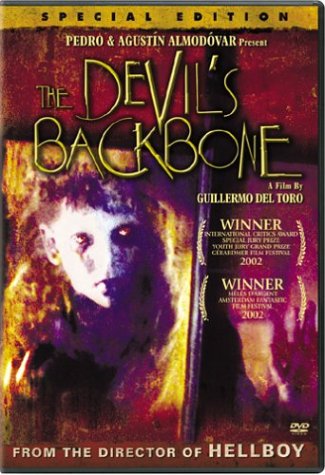
This struggle between two kinds of evil in a generally innocent (ignorant world) forms the crux of most of his later films — The Devil’s Backbone, Blade II, the two Hellboy films and Pan’s Labyrinth.

The Devil’s Backbone (2001) is about standing up for the truth, to make right one wrong with another. The events of the film begins much before arrival of Carlos to the orphanage — with Shanti’s death. Now, Shanti must be avenged. That’s not a choice. But there are other choices and everyone must choose, and what they choose will determine their fate. Though there is a visible ghost, The Devil’s Backbone is not a typical ghost film. The plot points deal with not what the ghost wants the children to do, but what the children are forced to do as opposed to the choices made by the adults.

In the Hellboy series, the poster featuring Hellboy (immortalised by Ron Pearlman) has to say: He’s on your side. Otherwise, it would be difficult to distinguish for whom the audience should root. Hellboy is equally ugly and obnoxious as his nemesis. At the end, the issue is resolved because he makes a choice. In the director’s commentary section of Hellboy II: The Golden Army, Del Toro mentions how the only character with a definitive moral stand in the film is Prince Nuada, the villain of the piece. There we are.

In Pan’s Labyrinth, fairy tales takes a darker route. Like most fairy tales, the young heroine Ofelia is given three tasks to regain her kingdom. But the tasks are murderous, and the enemies she meets, real or imaginary, are beyond her control. At the end, here too, it comes down to a choice. Will she choose her young sibling? Another interesting thing Del Toro does with Pan’s Labyrinth is creating confusion by telling everything. At the end, we are shown that Ofelia finds her kingdom in the underworld. Is it real, or was it all Ofelia’s imagination? You are not sure because in the movie world of Guillermo Del Toro, there is no simple happy endings.

Guillermo Del Toro filmography
1993 Cronos
1997 Mimic
2001 The Devil's Backbone
2002 Blade II
2004 Hellboy
2006 Hellboy: Sword of Storms; Pan's Labyrinth
2007 Hellboy: Blood and
Hellboy II: The Golden Army

Monday, November 01, 2010

Winter’s Bone

Winter’s Bone (2010)
Director: Debra Granik
Writers: Debra Granik (screenplay), Anne Rosellini (screenplay)
Stars: Jennifer Lawrence, John Hawkes and Garret Dillahunt
Runtime:100 min


The tendency to name everything, put a level, segregate everything neatly into compartments is very much an American phenomenon. In American cultural psychology, things are always either...or. Therefore, at the first glance, it’s very difficult to conceive Winter’s Bone as an American film. The film is as removed from Hollywood as humanly possible. And how do you categorise the film — thriller, neo-noir? a morality melodrama? Writing in The Guardian, critic Peter Bradshaw calls it hillbilly-gangster-realist-noir. It’s all those things; yet Winter’s Bone is a unpolished gem which defies immediate labelling.

The first few frames of Winter’s Bone can rival the setting of any post-apocalyptic horror films. The setting is the Ozarks mountains in rural Missouri. It’s winter and desolate. You see run-down cars gathering dust near dilapidated houses. There are sofas out in the open. Families still own horses, and hunt for food. It’s a place where the fabled American Dream forgot to make a visit. There are a few modern amenities, like electricity, fridge, but they all look like from another century. Where timbre is the crop, you can visualise the palpable poverty, and you also understand why the community, spread over the mountain (they are all related some way or other), has an unspoken criminal past, which must be honoured and protected.

Within this background, we are introduced to 17-year-old Ree (Jennifer Lawrence), the star of Debra Granik’s second film Winter's Bone (2010). Adopted from the eponymous 2006 novel by Daniel Woodrell, the film won the Grand Jury Prize: Dramatic Film at the 2010 Sundance Film Festival, and since has garnered rave reviews from critics. Some claim Lawrence is a sure shot candidate for best actress Oscar, and it’s not very difficult to see why.

The first fifteen minutes of the film establish the harsh environment of the heroine’s existence in no uncertain terms. Her mother is catatonic, those pills are not helping. She has two underage siblings. They haven’t seen their father for a long time. They have no visible income, and for food and wood, they are at the mercy of their neighbours, who proposes to adopt the brother, but Ree won’t allow it. She has a sense of pride which is not broken at the face of adversity. They look at the neighbour skinning a deer, the brother suggests if they should go and ask for some meat. Ree admonishes: “Don’t ask for things that aught to be given.” She is trying to survive on her own terms. She contemplates joining the army for the money you get for signing up.

One day, the Sheriff comes calling. This is always a bad sign. The Sheriff, little apprehensive to be in the neighbourhood, tells Ree the bad news: Her father, Jessup, when arrested, had put his house, and all his property in the bail bond. Now, he has jumped parole. If he does not show up within a week, the law will take house. Ree is pushed to the wall, and all she could say, “I’ll find him.”
Now, begins Ree’s journey to the clan members looking for a word on her father. A terrible secret lurks regarding Jessup, who used to cook crystal meth. Every time she tries to push for information, things become more complicated. There’s her uncle, Teardrop, she does not know how he feels about his brother’s family, there is one Trump, the arch-patriarch with whom no one wants to mess with. Ree is beaten up. This could hardly stop her. She has no other choice but to carry on. She cannot let the law take away their house.

At the end, Ree’s journey takes us to a lake in the middle of the winter night, to a terrible truth, and to a terrible act. To resolution. The resolution is not important, what important is the journey, and how director Granik charts it out for the audience, clinical, dispassion, and with a huge heart.

This is surprising how Granik handles such a volatile subject without any histrionics, without any forced action. The violence in the film lurks beneath the surface, and it’s so palpable that to show violence on-screen would be redundant. Even the scene when Ree is beaten up is off-screen. This restrain is admirable.

Same goes the way Lawrence plays Ree, stoic, practical, smart and not overtly emotion. In the entire film, she gets emotional just once, when in a weak moment, she asks her mother for help. She knows she cannot help, but she wishes for a moment, before taking the task upon herself.

John Hawkes, who plays Teardrop, for the tattoo he wears, also brings out this ambivalence of his character. Everyone is scared of him; but he does not wear his aggressiveness in his sleeves, it’s his nonchalant that more dangerous than any threat he may issue.

Towards the end of the film, there is a scene between Ree and Teardrop where the uncle tells Ree that her father is dead and she mustn’t tell him the name of the killer even if she learns the truth. Otherwise, he would have to go after him, and that won’t be good. This explains a lot about the characters.
In short, Winter’s Bone is a perfect little film that needs to be seen and appreciated. It’s understated ferocity is to be seen to be believed. This film may be one of the reason why we should still have faith in independent cinema. There was a time independent cinema was the next best thing (Steven Soderbergh), then, in the new millennium, it all fizzled out. But, independent cinema is not dead, in US or elsewhere. Winter’s Bone is a testament to this fact.