You reach home
Finally
You are glum, despondent
Exhausted…
You need a break
You open a lonely lock
Of a lonely room
You are the lord of all
You survey, and
There’s none to dispute
It’s your world, you kitchen
And your bed
To hell with the world
You are your own world
There’s no competition
No fights
No bickering
No tension…
There’s no, nothing
The world is dead
It’s you
You
You
You lie on your bed
You close your eyes
You dream
You need someone to share
Your world
DJS
Monday, October 30, 2006

Sunday, October 29, 2006
The Yellow Evening
The yellow leaf of the banyan tree falls with the
Yellow evening
And the smile less smile on my face
Mrs. Barua switches on the lights
Don't look at my daughter that way Akan
Why, look at me. When I am around
Why do you have to look somewhere else?
Are my cheeks not supple?
Are my…
I do use the cream my husband sent for me
Her husband lives abroad. But she stayed back
For, the kids must learn their own culture
Don't sit that way Anadi; I cannot see your face.
Huh, your eyes are wicked.
You liked my new dress?
He is a nice man—but…
Are you?
I dream about the dinner to be followed.
Her dal-rice is out of the world.
My husband—
You know Mrs. Saikia
She is so—
You know, this lady Bandana?
She asked me once, if I would work in a movie
My husband said no. He is so busy
He doesn't have even time to eat
He keeps calling me
But I don't like to go to abroad
He has to stay there. Money is a different proposition.
I wonder what he might be doing now
(Sleeping with someone?)
Thinking about me?
Huh!
And dreams about the place where her husband lives
Hey where are you looking at?
Look at me
He never thinks about me
She blushes
Her pallu slips over her shoulders,
Does Akan? Hey, I am talking to you.
The yellow evening dies.
DJS
Yellow evening
And the smile less smile on my face
Mrs. Barua switches on the lights
Don't look at my daughter that way Akan
Why, look at me. When I am around
Why do you have to look somewhere else?
Are my cheeks not supple?
Are my…
I do use the cream my husband sent for me
Her husband lives abroad. But she stayed back
For, the kids must learn their own culture
Don't sit that way Anadi; I cannot see your face.
Huh, your eyes are wicked.
You liked my new dress?
He is a nice man—but…
Are you?
I dream about the dinner to be followed.
Her dal-rice is out of the world.
My husband—
You know Mrs. Saikia
She is so—
You know, this lady Bandana?
She asked me once, if I would work in a movie
My husband said no. He is so busy
He doesn't have even time to eat
He keeps calling me
But I don't like to go to abroad
He has to stay there. Money is a different proposition.
I wonder what he might be doing now
(Sleeping with someone?)
Thinking about me?
Huh!
And dreams about the place where her husband lives
Hey where are you looking at?
Look at me
He never thinks about me
She blushes
Her pallu slips over her shoulders,
Does Akan? Hey, I am talking to you.
The yellow evening dies.
DJS
Present Perfect
“I’ve quit,” he announced one evening
As we sat and sipped tea, that
If I were to write this story, I’d have said:
“…and the cup fell from my hand,
Splitting tea all over…”
I relished the tea, kept the cup on the table
And stared at him
“Ain’t you surprised?”
I was surprised very much.
The job was more than a livelihood to him
It was the living proof of his existence.
But he wanted to do something else in life,
To climb the Mt Everest, for instance
Or at least to try for it
I said no, I wasn’t
“Tell me, did I do any wrong?”
You tell me, I asked
“I’ll miss the job,” his eyes were moist
“The company, the perk, you and all others…
“But…
“Forget it
“It’s my decision and I’ll reap it
“Now, it’s me, it’s me
“Now, it’s I and the world…
“I…”
Forget fortunetelling, tarot cards
Numerology
His present is picture perfect.
DJS
As we sat and sipped tea, that
If I were to write this story, I’d have said:
“…and the cup fell from my hand,
Splitting tea all over…”
I relished the tea, kept the cup on the table
And stared at him
“Ain’t you surprised?”
I was surprised very much.
The job was more than a livelihood to him
It was the living proof of his existence.
But he wanted to do something else in life,
To climb the Mt Everest, for instance
Or at least to try for it
I said no, I wasn’t
“Tell me, did I do any wrong?”
You tell me, I asked
“I’ll miss the job,” his eyes were moist
“The company, the perk, you and all others…
“But…
“Forget it
“It’s my decision and I’ll reap it
“Now, it’s me, it’s me
“Now, it’s I and the world…
“I…”
Forget fortunetelling, tarot cards
Numerology
His present is picture perfect.
DJS
Saturday, October 28, 2006
Christopher Benninger: Art Of An Architect
 For city-based architect Christopher Benninger, creativity has nothing to do with good or bad times. Here he shares with Dibyajyoti Sarma his vision of art in designing buildings
First, it’s time to get real. In the past few years Pune seems to have got caught in the frenzy of the real estate boom. Every other day there’s a new building in the city. Builders are having a gala time. Isn’t this a good time for architects as well, considering they are the beginning of any real estate project?
Ask this question to Christopher Benninger, and you will get an answer totally unexpected. "Like the law profession, the word architect has a number of meanings," he begins.
"And certainly, for people involved in municipal drawings and those who act as facilitators of increased FSI, it is a good time." But for Benninger there is no good time or bad time for an artist or a creative person.
Then he quickly provides a rejoinder. There is nothing wrong with statutory drawings and so on. "But this is not the life of an artist or a creative person! It is the life of the draftsman and the negotiator. Creation is a patient search, not a grinding work. It is a continuous process, not an event driven by a boom in the economy, or the ups and downs of the market."
This is Christopher Benninger for you, architect par excellence. He is no longer a name but a brand in architectural designs, whose design of the Mahindra United World College of India (in Mulshi) won him the Designer of the Year award in 1999, and American Institute of Architects Award in 2000.
Christopher Charles Benninger was born in the US in 1942, but has lived in India for the last 33 years, a decision he calls a "self-imposed exile". He studied city planning at MIT, and architecture at Harvard. A Fulbright Fellowship in 1968 brought him to Ahmedabad, where he founded the School of Urban Planning in 1971. He is an artist following the vision as Gandhi said, "Live in a village and plan for the world."
His firm, Christopher Charles Benninger Architects Pvt Ltd in Pune, functions like an American studio having its work bases in India and branches overseas. The studio has designed new towns and large housing projects for urban development authorities and state housing boards. There are more than 25 professional architects, urban designers, urban planners, landscape architects, interior designers, and engineers working in two studios at Pune and Thimphu, Bhutan.
Forget real estate. Architecture is a different ballgame altogether. For Christopher the current building scenario and the current architectural scenario are only vaguely inter-connected. In architecture there is the same amount of creative activity going on as it was three years ago, or a decade ago. But in building work, "yes, there are lots of boxes packaged in gift-wrapping - aluminum cladding, or sandstone, or some other fad."
There’s nothing wrong with that, he clarifies. "I like glass too! But there is a poetry even in the way we take a bath, and more so in how we play around with glass and metal cladding. Much of what is happing is a sad joke! People have just discovered that what is "chic", fashionable, and popular in the West, is also what is cheap, boring, and uninspiring! There is a good marriage taking place between making more money per square foot and doing cheap buildings that "look foreign".
Then he explains: "Let’s not confuse this paradigm with a creative paradigm. Let’s not confuse the search for money and the search for meaning! Architecture is a search for transcendence! The current architectural scenario is slow-paced, difficult, and painstaking."
About his own slow-paced, difficult, and painstaking journey to architectural designs, especially the projects he is working in Pune, he mentions three commissions. One is the Samundra Maritime Institute, Singapore. "We have used glass and steel and found poetry in the two working together. We have explored new spatial experiences in the way we have molded glass and steel; in the way one moves in the fabric of build. We have composed a large canvas of external space by putting very strong "markers" in that space, so that, the space is given definition. These markers are very large and sculpturesque. There is a play of the horizontal, of the things which seek the earth, against things which are vertical, phallic, and seeking the sky. There is a dynamic tension created, like between a man and a woman. There is a sense of something new, experimental, and even taboo! But it is exciting and energising."
Second, the Suzlon Wind Energy Systems Corporation world headquarters campus. "Instead of grabbing maximum FSI, they are opting for an ideal corporate environment."
Finally, "We are designing an international residential school at Amby Valley for Seemantho Roy, who wants something very special. This is a great challenge in the hilly terrain of the Western Ghats. We are building much of the campus underground, but using the natural slope so that the lower side opens out to courtyards and a fantastic view of the mountain ranges."
Sounds impressive. But unlike many others, Christopher hasn’t made forays into doing residential complexes so far. He begs to differ. "As you know I designed Tain Square. We were able to create the finest residential property in Pune there, and also we could convince the client to make a social investment in a public domain, the open public plaza itself. The atrium in Tain Square One, which is complete, is the most dramatic atrium in the city. Not even a five-star hotel can challenge this."
So what does a typical "Christopher Benninger Design" look like? He provides his first building, the Alliance Française building in Ahmedabad, built in 1973, as an example. There are some other examples - the Centre for Development Studies and Activities, the Mahindra United World College of India, and more recently the international campsite at Nilshi. Also Dr Oswal’s new centre for life sciences, health, and medicine on NIBM Road. Christopher explains: "Once an artist has found his own language he can use it to scribble down endless designs! They may have different lyricism and poetry, but they are all created from the same language. Language in architecture is based on principles, just like Hindi is based on grammar."
The Benninger Principles
a) Use materials in their natural form: Honesty in Expression!
b) Use human scale as your measuring stick: Humanism!
c) Integrate structures with their contexts assessing what is positive and what is negative in the context: Critical Regionalism!
d) Draw elements from the local vernacular: Balance with Tradition!
e) Create public domains and convivial spaces: Balance with Community!
f) Bring the natural landscape into the buildings and the buildings into the natural landscape: Balance with Nature!
g) Use materials which are fabricated within a 100-kilometre radius of the site, and which the local labour force is comfortable in working with: Appropriate Technology!
h) Make the pedestrian the king and the vehicle the servant: Separate out all machine movement from within the campus, or urban neighbourhood. Putting People First!
i) Draw one’s proportions from the nearby physical features and find order from the landscape: Organic Architecture!
j) Find a secret geometry to unify all of the components into a holistic composition. Holism!
Verses of three magicians
Samir Tanti
Translated from original Asomiya
By dibyajyoti Sarma
Let me tell you about the three magicians
All the three are blind
The roads through which they walk are blind
The night they carry with them is also blind
They know the meaning of 3-crore years old light
They known many healings and magic
How darkness turn into light
How one mistake can correct another
Whatever you and your friend may want to know
You will receive each answer
All three are companions to each other
All three of them ban each other
The clouds in which they drench are blind
The wind that takes off the garment is blind too
From the days of wondering to civilization
They have the count of each day
And count the possibilities of pain of life and death
Wherever they go they create tales
Whatever they say are itself myths
All three of them do not have addresses
All three of them are nomads from somewhere
The river water they touch is red
The leaves that float in the water are also red
The kernels of their favourite fruits are red
The beginning and the ending of the day is also red
When silence takes hold of noise
They kiss the stone images
Coiling on their feet serpents pray
The serpents’ prayers bloat into blood
All three of them are their own will
They say hunger is the faith of the hungry
In hunger even god fades out
When they travel they pray for the dead
The living is the dead’s protest
When there is conflict of soil versus soil
Breaks away minarets, temples, airport, assembly
They know the mystery of bidden, forbidden
Also about conspiracy and confusion
All three of them secretly touch us
And check our blood pressure
In their flute cries barren man-woman
In their sorrow stars shed tears
In an animals cry breaks an entire millennia
In hundred years not a single man appears
Words look for word’s support
Words turn into a long procession
When they walk stones break
The heat sharpens the thorns
All the three magicians stand in third party
In third party there is no chance to tell lies
When man falls below humanity
Then only the skull can be seen
No skull carries mind, intelligence
Intelligence-less life is modern life
They know the end of a dictatorial regime
Also know the results of punishment and pride
When they talk about betrayal
They actually talk about our own uncertainties
All three of them are three ages
All three of them are name of void
Neither in nor out
Neither above nor below thirst
Lost dreams look for dreams
The knuckles of hand sparkle in the pupil of the eye
They know as many scripts are studied
As many events passed in as many ages
All those books are blind too
Their creators and narrators are all blind
With them there tickles a clock
Till the ending of light water, darkness
Translated from original Asomiya
By dibyajyoti Sarma
Let me tell you about the three magicians
All the three are blind
The roads through which they walk are blind
The night they carry with them is also blind
They know the meaning of 3-crore years old light
They known many healings and magic
How darkness turn into light
How one mistake can correct another
Whatever you and your friend may want to know
You will receive each answer
All three are companions to each other
All three of them ban each other
The clouds in which they drench are blind
The wind that takes off the garment is blind too
From the days of wondering to civilization
They have the count of each day
And count the possibilities of pain of life and death
Wherever they go they create tales
Whatever they say are itself myths
All three of them do not have addresses
All three of them are nomads from somewhere
The river water they touch is red
The leaves that float in the water are also red
The kernels of their favourite fruits are red
The beginning and the ending of the day is also red
When silence takes hold of noise
They kiss the stone images
Coiling on their feet serpents pray
The serpents’ prayers bloat into blood
All three of them are their own will
They say hunger is the faith of the hungry
In hunger even god fades out
When they travel they pray for the dead
The living is the dead’s protest
When there is conflict of soil versus soil
Breaks away minarets, temples, airport, assembly
They know the mystery of bidden, forbidden
Also about conspiracy and confusion
All three of them secretly touch us
And check our blood pressure
In their flute cries barren man-woman
In their sorrow stars shed tears
In an animals cry breaks an entire millennia
In hundred years not a single man appears
Words look for word’s support
Words turn into a long procession
When they walk stones break
The heat sharpens the thorns
All the three magicians stand in third party
In third party there is no chance to tell lies
When man falls below humanity
Then only the skull can be seen
No skull carries mind, intelligence
Intelligence-less life is modern life
They know the end of a dictatorial regime
Also know the results of punishment and pride
When they talk about betrayal
They actually talk about our own uncertainties
All three of them are three ages
All three of them are name of void
Neither in nor out
Neither above nor below thirst
Lost dreams look for dreams
The knuckles of hand sparkle in the pupil of the eye
They know as many scripts are studied
As many events passed in as many ages
All those books are blind too
Their creators and narrators are all blind
With them there tickles a clock
Till the ending of light water, darkness
Life’s little ironies
Life’s little ironies
You live them
The boy you fancy
Comes to you
To talk about his girlfriend
His pride and your envy
And how he kissed her
You want to kiss him instead
You sit facing him
Desire filling your heart
And you can’t do anything
He pats your knees lovingly
He wants to borrow your digital camera
To click his girlfriend’s face
On the Traditional Day
You want to click him, but say
Anything for him
He leaves
Now you are worried about your camera
DJS
You live them
The boy you fancy
Comes to you
To talk about his girlfriend
His pride and your envy
And how he kissed her
You want to kiss him instead
You sit facing him
Desire filling your heart
And you can’t do anything
He pats your knees lovingly
He wants to borrow your digital camera
To click his girlfriend’s face
On the Traditional Day
You want to click him, but say
Anything for him
He leaves
Now you are worried about your camera
DJS
Tuesday, October 24, 2006
Finally...
Finally on a hot afternoon
As he was taking a walk
After an unusually late lunch
He found the ultimate ambition
Of his life
“When I am dead,” he told me
With the mock seriousness of a priest
“I wish myself to be cremated
Only by books and printed matter,
And nothing else.”
Something was amiss there and
Something was almost lucid
He was a talented boy studying very hard
For Civil Services
His room was littered with every kind of
Books on history and Geography
‘But darling,” I ventured to contradict
“Human skin is very sticky,
And flesh is very hard
Your books won’t suffice”
‘What do you mean?” he shouted
He meant he wasn’t planning
To die immediately
It would be much after
He gets his his job
And a beautiful wife with whom
He can take long walks
Cars, bungalows, a collection of SRK movies
And an assortment of perfumed condoms
“By then, I will have enough books too…”
Was his conclusion
“But why books?”
“Don’t you realise?
After I get through this damn exam
I’m not going to read anything
For the rest of my life
Don’t you realise how much
I’ll miss these books?
“They say that soul is immortal,”
He spoke biting his nail
“I want the smoke of
Those unread books
To be mingled with
My soul.”
DJS
As he was taking a walk
After an unusually late lunch
He found the ultimate ambition
Of his life
“When I am dead,” he told me
With the mock seriousness of a priest
“I wish myself to be cremated
Only by books and printed matter,
And nothing else.”
Something was amiss there and
Something was almost lucid
He was a talented boy studying very hard
For Civil Services
His room was littered with every kind of
Books on history and Geography
‘But darling,” I ventured to contradict
“Human skin is very sticky,
And flesh is very hard
Your books won’t suffice”
‘What do you mean?” he shouted
He meant he wasn’t planning
To die immediately
It would be much after
He gets his his job
And a beautiful wife with whom
He can take long walks
Cars, bungalows, a collection of SRK movies
And an assortment of perfumed condoms
“By then, I will have enough books too…”
Was his conclusion
“But why books?”
“Don’t you realise?
After I get through this damn exam
I’m not going to read anything
For the rest of my life
Don’t you realise how much
I’ll miss these books?
“They say that soul is immortal,”
He spoke biting his nail
“I want the smoke of
Those unread books
To be mingled with
My soul.”
DJS
Do you love me?
Do you love me?
Answer
Say yes or no
What would you like to hear?
None
Both are same to me
Then?
Say it anyways, yes or no
Why?
Perhaps
With this, we can make a new start
Start?
Where?
This is the journey’s end
Only the last rite remains
The departure
DJS
Answer
Say yes or no
What would you like to hear?
None
Both are same to me
Then?
Say it anyways, yes or no
Why?
Perhaps
With this, we can make a new start
Start?
Where?
This is the journey’s end
Only the last rite remains
The departure
DJS
Thursday, October 19, 2006
A poem for you
Every morning you break my heart
And at night
When there’s no light
You mend it
To be broken
At your will
Again, in the morning
That’s my love
Surf beating the rock
Near the seashore
Seasons change
The rock remains
And at night
When there’s no light
You mend it
To be broken
At your will
Again, in the morning
That’s my love
Surf beating the rock
Near the seashore
Seasons change
The rock remains
Tuesday, October 17, 2006
Views From The Edge: Randhir Khare
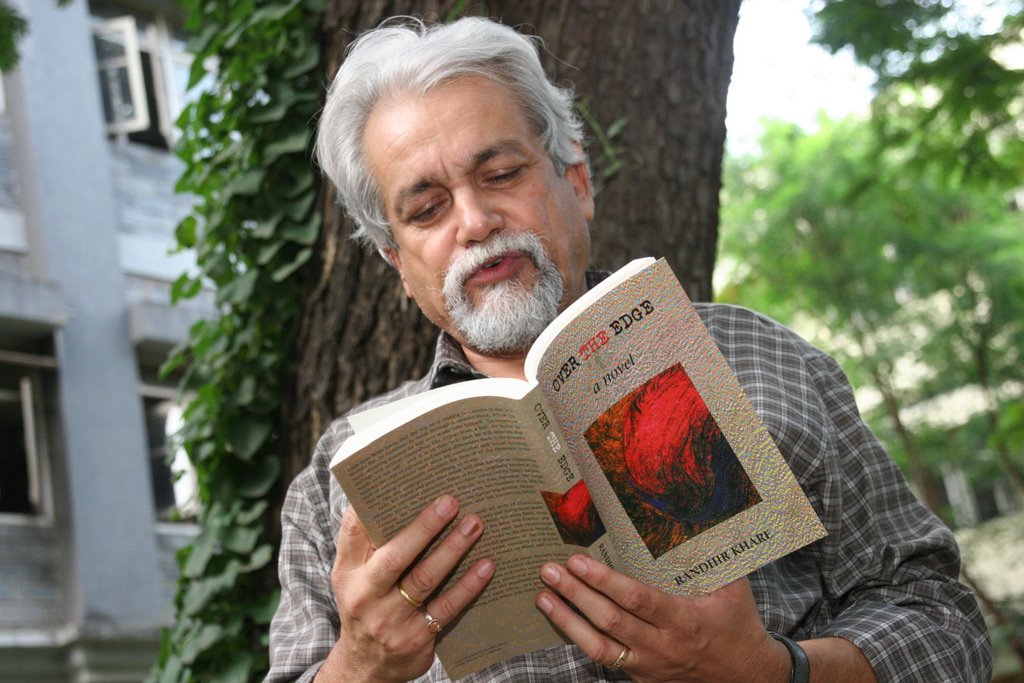 TO crack a writer’s block, Biren travels to Calcutta. But this unsuspecting journey soon turns into an obsessive journey of self-discovery entwined with the lives of unknown strangers into a web of relationships. Soon, for Biren, the journey turns into journey between living and dying, waking and dreaming, losing and finding, until he is drawn over the edge and falls into his real self. This is the crux of Randhir Khare’s new novel 'Over The Edge'. Published by Rupa, Khare calls this seven-and-half years in making novel a book about arrivals and departures… about finding when not searching, about arriving without even starting the journey.
A novel after a long time. But Khare, the writer, is never been less prolific. He is not sure whether ‘prolific’ is the right word. However, "Yes, I have been writing quite steadily." So, why the novel took so long? Was it a writer’s block, very much like his protagonist? Khare answers a firm no. He was not struggling with writing but "the narrative needed its own time and space to evolve." Khare explains how the earliest form of the novel was actually a dream notebook. "I had a habit of keeping a notebook on my bedside table and used to jot down the details of my dreams. These jottings were very impressionistic, very strong images and very vulnerable."
After the notebook was filled cover to cover, Khare began to respond to those images. "Whilst drawing these images, deeper ideas and feelings began creeping in. I put it away for a year or so. Later, I looked at it again and began to aesthetically refine the words and the language. In some cases, I developed the thoughts even further. By the time I had finished, the new dream notebook looked nothing like the original one. It had transcended the latter and had become, in its own way, a work of art, the beginning of the novel."
And this is what typifies Khare’s approach to writing. "I think it was Saul Bellow who compared his process of writing to that of an archaeologist. He starts digging and slowly uncovers an entire city."
Novels all right. But Randhir Khare is not your regular novelist. He is a writer first and foremost, experimenting in all forms of writing, from poetry to short stories, to travel writing to translation of tribal songs. It has been a long and varied literary journey, covering many genres and many aspects, from the realm of fantasy to the realism of the tribal world. How does he manage this transition from one facet of things from another, from one genre to another?
The answer comes immediately. "That’s the way I do it…" Then he explains. "My writing expresses my life, beliefs and preoccupations. I choose the genre by instinct, an instinct that has organically evolved over the years. The subjects I choose demand their own form - if I am to be honest I have to respond to those demands!"
This is the precise reason why Khare began to explore visual art and began to use pen and ink to express ways of perceiving and feeling that he could not articulate through words. Khare does not want to call himself an artist. But he’s an artist nonetheless. He has illustrated his own books, have had two solo exhibitions - in Pune and Mumbai - and had had my work in the collections of private collectors.
Apart from art, Randhir Khare has published 12 volumes of poetry, short fiction, novel and a futuristic fable. He is the recipient of Pegasus - the Union of Bulgarian Writers’ Gold Medal for Poetry and the Sanskriti Award for Creative Writing in India. And thus genre is not really an issue for him. "However varied the forms of writing may be, finally they all are an expression of certain core concerns: the life, struggle and dilemma of the outsider, the in-between and the social, cultural, intellectual and emotional minority - the one who shuttles between worlds or gets crushed when worlds collide."
The reason why Khare is fascinated by Anglo-Indian characters is a story of personal history. "I have written about Anglo-Indian characters and their lives because I understood (and still do) the community." His paternal grandfather (Raghubir Prasad Khare, to whom 'Over The Edge' is dedicated) belonged to a rich landowning family in Uttar Pradesh, a criminal lawyer who married Helen Yeats, the daughter of an Irish Indigo planter. Again, his maternal grandfather was an Englishman married to a Spanish lady.
For Khare this history is very important. Because, "this is me, this is what I am made up of. Though ‘technically’ I am not an Anglo-Indian, I nevertheless can understand their struggle to be accepted. They were (and are in some cases) the in-between ones who if they did not ‘integrate’ were either isolated or crushed when the eastern and western worlds collided in conflict. My concern was to tell their story as intimately and robustly as possible so that their lives were given a ‘human significance’ - beyond the stigmas that had been attached to them. Not only Anglo-Indian, but any kind of minorities, or in-between people, as Khare puts it, fascinate him. "The tragic and heroic struggle of in-between people has been happening everywhere, all over the world… I would place the tribal/traditional communities in India together with them. Not that they are a result of ‘obvious fusion’ but more because they are minority. This is the reason why I am so compelled to write about tribal realities."
Indian writers writing in English cannot really escape the ever-confusing debate over Indian Writing in English. For Khare, Indian Writing in English is alive and well. In fact, it’s robust. In this ‘ocean’ there’s enough room for all sorts of life to survive and flourish… We have our hermit crabs and our flying fish. So - cheers to that. May diversity survive!"
Randhir Khare currently teaches at Wadia College. However, this is only one of his many roles. He has been involved with various activities in various fields: from a poet, writer, to a teacher to activist… "All of the activities are my way of responding to life, of contributing to life (I don’t really care whether this contribution is acknowledged by others or not, this is not why I do these things!)," explains Khare. But it is his writings that his life experiences are articulated. "Writing for me is my way recording and clarifying… for myself and for others. I am a writer. First." But his work in education continues as does his contribution to tribal welfare. And he is already working on his new Book, called 'The White Cranes Of Sundargarh'. "It is a face off between destiny and individual choice," he explains.
Khare Ka Khazana
Hunger (Poetry)
Selected Poems (Audio cassette)
Thirteen Poems (Poetry)
The Circle (Poetry)
Survivors (Stories)
Return To Mandhata (Selected Stories)
Swimming Into The Dark (Poems)
Notebook Of A Footsoldier (Stories)
Dangs: Journeys Into The Heartland (Travel/Social Documentation)
The Last Jungle On Earth (Fable)
The Singing Bow: Song Poems Of The Bhil (Translation)
‘Do Rats Have Rights?’ (Essays)
KUTCH, Triumph Of The Spirit (Travel/Social Documentation)
River Day (Poems)
Call Of The Blue Mountains (Essays)
Over The Edge (Novel)
Thursday, October 12, 2006
Kolatkar's horses and other memories
The year 2004 would always be remembered, among other things, as the year when an era of Indian Literature came to an end. It was the year noted English and Marathi poet Arun Kolatkar passed away.
When a certain journalist hears the news of Kolatkar’s death on the fateful day, she is overpowered by the memory of meeting the poet in person, years ago in a restaurant in Kolatkar’s favourite Kala Ghoda area in Mumbai. She gradually begins to recall how she first heard of the man, then read his poems, and the events that eventually led her to meet the reclusive poet himself. As the journalist relapses to her memory, poetry and music come forward to complete the ensemble, to recreate the personality already gone.
This is the premise on which the play, Dark Horse: Walking Down Arun Kolatkar’s Lane, to be performed at Chandrashekhar Auditorium, IUCCA, today at 6.30 pm, is built. Scripted, directed and music provided by Gowri Ramnarayan, the play is produced by JustUs Repertory, Chennai, and boasts of a well-known cast, including Dhritiman Chaterji as Kolatkar, who starred in Satyajit Ray’s cult film Pratidwandi.
But the play is neither the auto/biography of Kolatkar, nor the dramatisation of his poem. Both the things are there, but there’s more. It’s a memory play, of past and present, of poetry and music, of imagination and reality, and an attempt to understand the recluse icon of Marathi as well as English poetry, Arun Kolatkar. In short, it is an ensemble of poetry, music and conversation.
Satish Alekar, head of the Centre for Performing Arts, which presents the play along with the University of Pune and IUCAA, feels that "It is not an easy play to understand." To begin with, it is not a biography of Kolatkar. It is an imaginary play, where the narrator tries to recreate the personality of the poet from his poems.
A novel idea indeed. There’s no straightforward narrative here. The subject is seen from a distant reality, from a different point of view and at a different time. You may probably call it a memory play, a genre made popular by Tennessee Williams' play The Glass Menagerie, the echoes of which can be heard in Vijay Tendulkar's Marathi play A Friend’s Story, which incidentally was translated by Gowri Ramnarayan, director of the present play.
Ramnarayan is not only a writer and translator, but also has been a vocal accompanist to Carnatic musician M S Subbulakshmi. Thus, music plays an important role in the play. But music is not an accessory here; it is the focal point that combines the different threads of conversation, memory and poetry. The play uses 10 poems by Kolatkar, but they are not recited or dramatised, but assimilated into the theme.
Kolatkar’s Jejuri not only made the ancient temple town a famous name, but also changed the face of Indian poetry, especially modern Marathi poetry for generations to come. His The Kala Ghoda Poems, on the other hand, deals with the ‘city without a soul,’ his beloved Mumbai.
It is the Kala Ghoda aspect of the play that is most exciting for R Raj Rao, noted poet and writer. "Since the interview between the journalist and the poet takes place in a café, which obviously is the Wayside Inn, the play is bound to be profound," says Rao. "The Wayside Inn, after all, in the Fort area of Mumbai, was the place where Kolatkar spent most of his working day, and here his creative powers were at their best."
Come, spend an evening in memory of Kolatkar...
The play was performed on Oct 13, 2006
When a certain journalist hears the news of Kolatkar’s death on the fateful day, she is overpowered by the memory of meeting the poet in person, years ago in a restaurant in Kolatkar’s favourite Kala Ghoda area in Mumbai. She gradually begins to recall how she first heard of the man, then read his poems, and the events that eventually led her to meet the reclusive poet himself. As the journalist relapses to her memory, poetry and music come forward to complete the ensemble, to recreate the personality already gone.
This is the premise on which the play, Dark Horse: Walking Down Arun Kolatkar’s Lane, to be performed at Chandrashekhar Auditorium, IUCCA, today at 6.30 pm, is built. Scripted, directed and music provided by Gowri Ramnarayan, the play is produced by JustUs Repertory, Chennai, and boasts of a well-known cast, including Dhritiman Chaterji as Kolatkar, who starred in Satyajit Ray’s cult film Pratidwandi.
But the play is neither the auto/biography of Kolatkar, nor the dramatisation of his poem. Both the things are there, but there’s more. It’s a memory play, of past and present, of poetry and music, of imagination and reality, and an attempt to understand the recluse icon of Marathi as well as English poetry, Arun Kolatkar. In short, it is an ensemble of poetry, music and conversation.
Satish Alekar, head of the Centre for Performing Arts, which presents the play along with the University of Pune and IUCAA, feels that "It is not an easy play to understand." To begin with, it is not a biography of Kolatkar. It is an imaginary play, where the narrator tries to recreate the personality of the poet from his poems.
A novel idea indeed. There’s no straightforward narrative here. The subject is seen from a distant reality, from a different point of view and at a different time. You may probably call it a memory play, a genre made popular by Tennessee Williams' play The Glass Menagerie, the echoes of which can be heard in Vijay Tendulkar's Marathi play A Friend’s Story, which incidentally was translated by Gowri Ramnarayan, director of the present play.
Ramnarayan is not only a writer and translator, but also has been a vocal accompanist to Carnatic musician M S Subbulakshmi. Thus, music plays an important role in the play. But music is not an accessory here; it is the focal point that combines the different threads of conversation, memory and poetry. The play uses 10 poems by Kolatkar, but they are not recited or dramatised, but assimilated into the theme.
Kolatkar’s Jejuri not only made the ancient temple town a famous name, but also changed the face of Indian poetry, especially modern Marathi poetry for generations to come. His The Kala Ghoda Poems, on the other hand, deals with the ‘city without a soul,’ his beloved Mumbai.
It is the Kala Ghoda aspect of the play that is most exciting for R Raj Rao, noted poet and writer. "Since the interview between the journalist and the poet takes place in a café, which obviously is the Wayside Inn, the play is bound to be profound," says Rao. "The Wayside Inn, after all, in the Fort area of Mumbai, was the place where Kolatkar spent most of his working day, and here his creative powers were at their best."
Come, spend an evening in memory of Kolatkar...
The play was performed on Oct 13, 2006
All that Jazz
The Golden Globe Awards, conferred by Hollywood Foreign Press Association, divide films into two major categories, drama, and comedy or musical. Last year, the award for best film in comedy or musical category was given to Walk the Line, the Johnny Cash biopic. But the film is not your conventional Hollywood musical.
In Hollywood, musical is a genre with its own tradition and history, where songs and dances are infused within the narrative in such a way that you cannot dream of the film without the songs. Remove the songs, and The Sound of Music or My Fair Lady would appear lifeless.
Musicals are American invention, a cross between European opera or serious stage drama. And it has its roots in theatre, in Broadway, to be precise. Stage musicals are essentially comedies in which songs and choruses, instrumental accompaniments and interludes and often dance are integrated into dramatic plot.
It was developed in the theatres along Broadway in New York in the early part of 20th century.
There were several composers such as George Cohan, Victor Herbert, who popularised musicals in theatres. Then came the pair of Richard Rodgers and Oscar Hammerstein who took musicals to new heights with compositions like Oklahoma!, The King and I, South Pacific, Carousel, and the most famous of them all, The Sound of Music.
Hollywood Musical is a journey from stage to the silver screen. When The Jazz Singer spoke a few words for the first time on screen, there was an increasing demand, for not only sound in films, but also, songs and music. Hollywood producers naturally turned to Broadway musicals, and a new genre was born.
A musical is usually known by its composers. We know The Sound of Music as work of Rodger and Hammerstein, or Evita as work of Andrew Lloyd Webber.
Earlier, musicals were songs and dance extravaganza, like Seven Brides for Seven Brothers, and sheer fantasy like The Wizard of Oz.
In 1961, Robert Wise’s West Side Story changed the face of musicals forever. Romeo and Juliet reincarnated as Tony and Maria in New York, who gave love a new meaning (‘I have a love’), thrilled generations of movie-goers and produced numerous mutants (including the Michael Jackson song, ‘Beat It’).
Three years later musical reached its zenith with My Fair Lady, the story of a flower girl turned into a socialite. The Broadway success with Julie Andrews as Eliza Doolittle was reborn in celluloid with Audrey Hepburn and Rex Harrison, coupled with beautiful songs like, ‘I could have danced all night’, ‘the rain in Spain,’ among others.
Singer-accretes Julie Andrews carved her own niche on screen with films like Mary Poppins and The Sound of Music, perhaps the most popular of all musicals.
There are numerous other names, the Fred Astaire movies, Gene Kelly’s Singin’ in the Rain, Deborah Kerr and Yule Brynner’s The King and I, and so on. It was the golden age of musicals.
In 1970s musical discovered a youthful face in Saturday Night Fever. The story of a Brooklyn lad who dreams to be the king of dance floor made John Travolta a star. A year later Grease lit the screen to make Travolta and Olivia Newton-John youth Icons.
The magic of youthful exuberance and freshness of these musicals was again recreated in Dirty Dancing. The chemistry between Jennifer Grey and Patrick Swayze was something to see to believe.
In 1986, Madonna started as Eva Peron in Evita. The story of a B-grade actress who rose to become the first lady of Argentina, Madonna relived the aura of Eva to the hilt, with Antonio Banderas offering ample support. The songs, especially, ‘Don’t cry for me, Argentina,’ gave the film an emotional edge.
Musicals are not always song and dance extravaganza. Within the perimeter of playfully entertaining medium, it tries to expose some deep seated conflicts. So, Fiddlers on the Roof is not only about a Tevye Milkman’s problems, but also about decaying Jewish tradition and the coming of Russian revolution. The Sound of Music is not only a family drama, but also talks about Hitler and Nazi Germany. My Fair Lady is about class difference in terms of speech while Chicago satirises the system of judiciary.
In a musical, songs are not an external element, but the highlight of the narrative. The songs bring out characters and their emotions to the fore. When Prof Higgins sings ‘I’ve grown accustomed to her face,’ we know he’s in love with Eliza. When Milkman sings, ‘If I were a rich man,’ we come to understand his personality. So, we know more about Maria through the ‘Maria’ song in The Sound of Music.
Another important aspect of a musical is that it always ends in happy ending. While Eliza leaves Higgins in G B Shaw’s original play, Pygmalion, in the musical they finally meet to live happily ever after.
Hollywood continues to make musical, the latest famous examples being, Chicago and Moulin Rouge. Despite being entertaining, somewhere these films lack the grandeur of the golden age of Hollywood musicals.
In Hollywood, musical is a genre with its own tradition and history, where songs and dances are infused within the narrative in such a way that you cannot dream of the film without the songs. Remove the songs, and The Sound of Music or My Fair Lady would appear lifeless.
Musicals are American invention, a cross between European opera or serious stage drama. And it has its roots in theatre, in Broadway, to be precise. Stage musicals are essentially comedies in which songs and choruses, instrumental accompaniments and interludes and often dance are integrated into dramatic plot.
It was developed in the theatres along Broadway in New York in the early part of 20th century.
There were several composers such as George Cohan, Victor Herbert, who popularised musicals in theatres. Then came the pair of Richard Rodgers and Oscar Hammerstein who took musicals to new heights with compositions like Oklahoma!, The King and I, South Pacific, Carousel, and the most famous of them all, The Sound of Music.
Hollywood Musical is a journey from stage to the silver screen. When The Jazz Singer spoke a few words for the first time on screen, there was an increasing demand, for not only sound in films, but also, songs and music. Hollywood producers naturally turned to Broadway musicals, and a new genre was born.
A musical is usually known by its composers. We know The Sound of Music as work of Rodger and Hammerstein, or Evita as work of Andrew Lloyd Webber.
Earlier, musicals were songs and dance extravaganza, like Seven Brides for Seven Brothers, and sheer fantasy like The Wizard of Oz.
In 1961, Robert Wise’s West Side Story changed the face of musicals forever. Romeo and Juliet reincarnated as Tony and Maria in New York, who gave love a new meaning (‘I have a love’), thrilled generations of movie-goers and produced numerous mutants (including the Michael Jackson song, ‘Beat It’).
Three years later musical reached its zenith with My Fair Lady, the story of a flower girl turned into a socialite. The Broadway success with Julie Andrews as Eliza Doolittle was reborn in celluloid with Audrey Hepburn and Rex Harrison, coupled with beautiful songs like, ‘I could have danced all night’, ‘the rain in Spain,’ among others.
Singer-accretes Julie Andrews carved her own niche on screen with films like Mary Poppins and The Sound of Music, perhaps the most popular of all musicals.
There are numerous other names, the Fred Astaire movies, Gene Kelly’s Singin’ in the Rain, Deborah Kerr and Yule Brynner’s The King and I, and so on. It was the golden age of musicals.
In 1970s musical discovered a youthful face in Saturday Night Fever. The story of a Brooklyn lad who dreams to be the king of dance floor made John Travolta a star. A year later Grease lit the screen to make Travolta and Olivia Newton-John youth Icons.
The magic of youthful exuberance and freshness of these musicals was again recreated in Dirty Dancing. The chemistry between Jennifer Grey and Patrick Swayze was something to see to believe.
In 1986, Madonna started as Eva Peron in Evita. The story of a B-grade actress who rose to become the first lady of Argentina, Madonna relived the aura of Eva to the hilt, with Antonio Banderas offering ample support. The songs, especially, ‘Don’t cry for me, Argentina,’ gave the film an emotional edge.
Musicals are not always song and dance extravaganza. Within the perimeter of playfully entertaining medium, it tries to expose some deep seated conflicts. So, Fiddlers on the Roof is not only about a Tevye Milkman’s problems, but also about decaying Jewish tradition and the coming of Russian revolution. The Sound of Music is not only a family drama, but also talks about Hitler and Nazi Germany. My Fair Lady is about class difference in terms of speech while Chicago satirises the system of judiciary.
In a musical, songs are not an external element, but the highlight of the narrative. The songs bring out characters and their emotions to the fore. When Prof Higgins sings ‘I’ve grown accustomed to her face,’ we know he’s in love with Eliza. When Milkman sings, ‘If I were a rich man,’ we come to understand his personality. So, we know more about Maria through the ‘Maria’ song in The Sound of Music.
Another important aspect of a musical is that it always ends in happy ending. While Eliza leaves Higgins in G B Shaw’s original play, Pygmalion, in the musical they finally meet to live happily ever after.
Hollywood continues to make musical, the latest famous examples being, Chicago and Moulin Rouge. Despite being entertaining, somewhere these films lack the grandeur of the golden age of Hollywood musicals.
Eating Rosogolla in Puri
The first thing that caught my attention in Puri was the use of the Bengali language. A mixture of language in a tourist place is a given thing. But what set me thinking was the use of the Bengali language alone. Why not Hindi or English? In South India, Hindi just wouldn’t help you. I remember how in Thiruvananthapuram I had a hard time dealing with a cab driver. I was speaking in Hindi which he even refused to acknowledge, even though, I am sure, he understood.
But in Puri it was different. In the whole of North East and beyond, Hindi is the lingua franca, the connecting language. Then why the predominant use of the Bengali in Puri?
Is it only because Puri is closer home to Kolkata, and it is Bengal’s very own tourist destination, or is there other reasons?
Welcome to Puri. Apart from jelebi-shaped Oriya scripts on the signboards, there’s nothing Orissa about Puri. The rickshaw-pullers talk to you in Bangla, you are welcomed into a hotel in Bengali by the receptionist, for lunch you eat bhat and macher jhol, and in the evening you eat rosogolla before arguing with a shopkeeper for an Orissa handloom kurta, of course in Bangla. Even the priests in the temple talk to you in that language. Make no mistake. These people are not Bangla natives. For them, the language is the part of their business plan.
From Howrah, Puri is just a 12 hours journey. Spend a jerky night in the train and the next morning you are at Puri. Does the size of a railway station can tell you the size of a city? If it does, then Puri is not a very big place. You get down with a hoard of Bengali tourists only to be accosted by rickshawallas, tourist agents, or temple pandas waiting to grab you like hungry wolves. You feel you are still in Bengal. Only that people around you look thin and emaciated. Probably the news of famous Orissa famines is working trick on you.
Sleeping towns have their own charm. It makes them look enormous and more beautiful than they really are. My destination is Swargadwar: the heaven’s gate, a place unbiased like the heaven itself, sheltering everyone from the pot-bellied Bengali bhadralok to the leper with bandaged feet. You cross the VIP Road, the official Puri, and come face-to-face with the sea. The road now runs straight. On your left is the sea, and on your right are the tourist lodgings, buildings with different shapes and sizes with endless nameplates in English, in Oriya, and of course, in Bengali.
Puri is at once a temple city and a sea-side resort. Don’t expect the deep blue Arabian sea of Bombay or Goa here. The sea looks dark and smoky; the breaking surf has the colour of mother-of-pearl. The Bay of Bengal is more of a severe kind, like a sage who has seen the world, very much part of it, yet seemingly detached. Legends say the sea water here has healing powers. It can cure any skin-related diseases. You sit on the seashore under the scotching sun, sip lemon juices, or bargain for sea-shell key chains or miniature terracotta statues of Lord Jagannath.
Come evening, it turns into a small-time fare, a Mina Bazaar of sorts. Eat Puri Bhaji, fish fry or chow-chow, buy conches of various sizes, or curios for your drawing room made of sea shells, or clothes from Oriya handloom, or just stroll about the place; it’s fantastic.
At the middle of Swargadwar, you see a concrete statue of Sri Gauranga Mahaprabhu beckoning you to him with his outstretching hands. Follow the road to his left hand; it will lead you to Bali Shahi, the seat of the famous Jagannath temple, one of the four dhamas of Hindu belief, God’s own house.
The temple has four gates on four sides, east, west, north and south, each door represented by an animal, east lion, west tiger, south elephant, and north horse.
The carved stone temple is the original structure, where the deities, the siblings reside. The front panel of the temple painted white and pink is a new addition. The main structure is surrounded by several small ones dedicated to numerous deities of the Hindu pantheon. Among them, the biggest one belongs to Mahalaxmi, next to her lives Saraswati.
In Hinduism, Gods are usually worshiped alone or in pairs. This is probably the only temple in India where three siblings are worshiped together. It is perhaps again the only temple in India where Balaram and Subhadra are worshiped as Gods.
Legends say once a log of wood was found floating at the sea, and the God appeared before the local king asking him to collect the log, carve idols from it and install it in a temple. The king collected the log, but he could not find any carpenters who could dare cut the log. Finally, one carpenter came forward. But he had a condition. He should not be disturbed while he was at work. So he locked himself in a room with the log of wood. Months passed, but the carpenter did not appear from his room. The queen, a kind-hearted soul, began to worry about the carpenter, and one day she ordered the room to be forced open. And lo, the carpenter was gone, and there remained three unfinished idols.
These three idols occupy the main dais of the temple: left Balaram, middle Subhadra and right Jagannath. The big brother wears a Neelam, and the younger a diamond. The sister has a pearl.
Whoever the carpenter was, who carved those statues, he was surely from down south. Each idol in Puri has unmistakable resemblance to the idols of South India. In South, there is an impressionistic trend in idol carving. In North, God is mirrored unto man, to the last plait of his dhoti.
The Gods in Puri are living Gods. They need to eat, drink and be merry. The families of Brahmins surrounding the temple pamper the siblings day and night. The priests awake them, give them bath, feed them, in the afternoon take them for a walk and finally at night lull them to sleep. The annual Rath Yatra notwithstanding, it's festival at Puri all though the year.
The name Puri means the dwelling place. It is the house of Lord Jaganath, and mind you, he is a gourmet God. He has the world’s largest kitchen were every day more than 400 cooks prepare food for him. When the Gods have eaten, the rest of the food is sold in the market as prasad.
While at Puri don’t forget to make a wish. The priests at the old baniyan tree will tell you how. Buy a thread from them and tie it in three knots on the tree and wish three wishes, no more, no less.
Despite the sea, it’s the temple which is the main source of livelihood for the people in Puri. Whatever may be the reason of your visit to Puri, everyone out here is after your money. That’s true of any holy places. However, compared to other temple cities, Puri is moderately cheap. Probably because Orissa is a poor state.
But the vendors wouldn’t leave you in peace. The local sellers of curios in any tourist place are patient like tiger and vicious like hyenas. They are an unfriendly lot, with the sole end to sell their good and earn a buck or two.
In the evening near the seashore, a small boy accosts me. He’s selling sea-shell key chains. He wants me to buy them. I ask him how he speaks fluent English, because, I guess, he is Oriya-speaking. He tells me that he can speak Oriya too, and Bengali and Hindi. But his mother tongue is Telugu. His father is a migrant fisherman from Andra Pradesh. And he goes to an English medium school, that when he's not selling the seashells.
Talk about the mixture of languages in a tourist place!
But in Puri it was different. In the whole of North East and beyond, Hindi is the lingua franca, the connecting language. Then why the predominant use of the Bengali in Puri?
Is it only because Puri is closer home to Kolkata, and it is Bengal’s very own tourist destination, or is there other reasons?
Welcome to Puri. Apart from jelebi-shaped Oriya scripts on the signboards, there’s nothing Orissa about Puri. The rickshaw-pullers talk to you in Bangla, you are welcomed into a hotel in Bengali by the receptionist, for lunch you eat bhat and macher jhol, and in the evening you eat rosogolla before arguing with a shopkeeper for an Orissa handloom kurta, of course in Bangla. Even the priests in the temple talk to you in that language. Make no mistake. These people are not Bangla natives. For them, the language is the part of their business plan.
From Howrah, Puri is just a 12 hours journey. Spend a jerky night in the train and the next morning you are at Puri. Does the size of a railway station can tell you the size of a city? If it does, then Puri is not a very big place. You get down with a hoard of Bengali tourists only to be accosted by rickshawallas, tourist agents, or temple pandas waiting to grab you like hungry wolves. You feel you are still in Bengal. Only that people around you look thin and emaciated. Probably the news of famous Orissa famines is working trick on you.
Sleeping towns have their own charm. It makes them look enormous and more beautiful than they really are. My destination is Swargadwar: the heaven’s gate, a place unbiased like the heaven itself, sheltering everyone from the pot-bellied Bengali bhadralok to the leper with bandaged feet. You cross the VIP Road, the official Puri, and come face-to-face with the sea. The road now runs straight. On your left is the sea, and on your right are the tourist lodgings, buildings with different shapes and sizes with endless nameplates in English, in Oriya, and of course, in Bengali.
Puri is at once a temple city and a sea-side resort. Don’t expect the deep blue Arabian sea of Bombay or Goa here. The sea looks dark and smoky; the breaking surf has the colour of mother-of-pearl. The Bay of Bengal is more of a severe kind, like a sage who has seen the world, very much part of it, yet seemingly detached. Legends say the sea water here has healing powers. It can cure any skin-related diseases. You sit on the seashore under the scotching sun, sip lemon juices, or bargain for sea-shell key chains or miniature terracotta statues of Lord Jagannath.
Come evening, it turns into a small-time fare, a Mina Bazaar of sorts. Eat Puri Bhaji, fish fry or chow-chow, buy conches of various sizes, or curios for your drawing room made of sea shells, or clothes from Oriya handloom, or just stroll about the place; it’s fantastic.
At the middle of Swargadwar, you see a concrete statue of Sri Gauranga Mahaprabhu beckoning you to him with his outstretching hands. Follow the road to his left hand; it will lead you to Bali Shahi, the seat of the famous Jagannath temple, one of the four dhamas of Hindu belief, God’s own house.
The temple has four gates on four sides, east, west, north and south, each door represented by an animal, east lion, west tiger, south elephant, and north horse.
The carved stone temple is the original structure, where the deities, the siblings reside. The front panel of the temple painted white and pink is a new addition. The main structure is surrounded by several small ones dedicated to numerous deities of the Hindu pantheon. Among them, the biggest one belongs to Mahalaxmi, next to her lives Saraswati.
In Hinduism, Gods are usually worshiped alone or in pairs. This is probably the only temple in India where three siblings are worshiped together. It is perhaps again the only temple in India where Balaram and Subhadra are worshiped as Gods.
Legends say once a log of wood was found floating at the sea, and the God appeared before the local king asking him to collect the log, carve idols from it and install it in a temple. The king collected the log, but he could not find any carpenters who could dare cut the log. Finally, one carpenter came forward. But he had a condition. He should not be disturbed while he was at work. So he locked himself in a room with the log of wood. Months passed, but the carpenter did not appear from his room. The queen, a kind-hearted soul, began to worry about the carpenter, and one day she ordered the room to be forced open. And lo, the carpenter was gone, and there remained three unfinished idols.
These three idols occupy the main dais of the temple: left Balaram, middle Subhadra and right Jagannath. The big brother wears a Neelam, and the younger a diamond. The sister has a pearl.
Whoever the carpenter was, who carved those statues, he was surely from down south. Each idol in Puri has unmistakable resemblance to the idols of South India. In South, there is an impressionistic trend in idol carving. In North, God is mirrored unto man, to the last plait of his dhoti.
The Gods in Puri are living Gods. They need to eat, drink and be merry. The families of Brahmins surrounding the temple pamper the siblings day and night. The priests awake them, give them bath, feed them, in the afternoon take them for a walk and finally at night lull them to sleep. The annual Rath Yatra notwithstanding, it's festival at Puri all though the year.
The name Puri means the dwelling place. It is the house of Lord Jaganath, and mind you, he is a gourmet God. He has the world’s largest kitchen were every day more than 400 cooks prepare food for him. When the Gods have eaten, the rest of the food is sold in the market as prasad.
While at Puri don’t forget to make a wish. The priests at the old baniyan tree will tell you how. Buy a thread from them and tie it in three knots on the tree and wish three wishes, no more, no less.
Despite the sea, it’s the temple which is the main source of livelihood for the people in Puri. Whatever may be the reason of your visit to Puri, everyone out here is after your money. That’s true of any holy places. However, compared to other temple cities, Puri is moderately cheap. Probably because Orissa is a poor state.
But the vendors wouldn’t leave you in peace. The local sellers of curios in any tourist place are patient like tiger and vicious like hyenas. They are an unfriendly lot, with the sole end to sell their good and earn a buck or two.
In the evening near the seashore, a small boy accosts me. He’s selling sea-shell key chains. He wants me to buy them. I ask him how he speaks fluent English, because, I guess, he is Oriya-speaking. He tells me that he can speak Oriya too, and Bengali and Hindi. But his mother tongue is Telugu. His father is a migrant fisherman from Andra Pradesh. And he goes to an English medium school, that when he's not selling the seashells.
Talk about the mixture of languages in a tourist place!
Wednesday, October 11, 2006
How to become a superman
How to Become a Superman: “Thus Spake Zarathustra”
Friedrich Nietzsche is probably the most famous and most misunderstood philosopher of the recent time and, notorious too. People say, Adolph Hitler was influenced by Nietzsche’s theory of Superman and the German philosopher was the very reason why Hitler entered into history’s bloodiest anti-Semite massacre. People say, Nietzsche was a sickly child and hence bitter about everything in the world where he could never find a place for himself. He poured out his bitterness into his philosophy criticizing everything in the world, including God, whom he declared as dead.
There is a certain film which begins with Nietzsche’s quotation, “God is dead” — Nietzsche. The screen goes black. After a few seconds there appears another quotation: “Nietzsche is dead” —God.
The reason why Nietzsche is notorious and yet most influential is that he dared to say things, which no one had even conceived before, and he said it with such punch and logic that you have to believe him. The greatness of Nietzsche as a poet comes to fore here in his lyricism[1], and in his terse almost epigrammatic, Baconian sentence construction filled with explosive radical idealism.
Thus Spake Zarathustra is the father of all inspirational books, which are in demand today. Zarathustra is the Prophet of the Prophets.[2] He is worth all the Richard Bach[3], Dale Carnegie[4], Napoleon Hill[5] and Deepak Chopra[6] put together. He is the crux of all religions. He is the teacher of all thinking mind.
Nietzsche and his Zarathustra are known for two things: their denunciation of God and the creation of Superman. Zarathustra’s reproof of god is not radical for its own sake. It is a logical development of his creation of what is called Superman. His superman is an evolved personality who is complete in itself and that is why he will not need any God. He writes: “Dead are all the Gods, now do we desire the superman to live: – let this be our final will at the great noontide.”
Nietzsche had great respect for the Greek civilization for, among the Greeks it was the individuals that counted.
The teaching of Zarathustra is the celebration of man, not the abstract man, but the real one with his feet rooted on the ground and an aspiration to soar high. He talks about body more than the soul. He celebrates the working of body, its basic instincts, and its natural demands and shows the road to achieve higher plane, not salvation, but to be a superman. Zarathustra does not explain what he means by superman, he merely says: “man is rope stretched between the animal and the superman—a rope over an abyss.”
Zarathustra celebrates man, and nothing else. He has an opinion about everything, he sees churches as sweet-smelling caves, woman as riddle, pity as vice: “God is dead, of his pity for man hath he died.”
The radicalism of Nietzsche lies in the fact that in his ambition to create Superman he has to reject everything on which the society is based, morality, religion, law and everything that comes under the scrutiny of the state: “The state I call it, where all are poison drinker, the good and the bad, the state where all lose themselves, the good and the bad, the state where the slow of all—is called ‘life’.”
When Zarathustra was 30 years old he left home and after wondering in the woods for 10 years he finally realised that his concern was man, not nature. He came down and began to preach: “I teach you the Superman. Man is something that is to be surpassed. What have ye done do surpass man?”
In the process of surpassing man, man has to surpass everything that is conventional. Here begins the radical cynicism of Nietzsche.
According to Zarathustra the best virtue is the world is the ability to sleep. There is nothing beyond the body. Jealously is the root of all unhappiness. The state is the cold of the coldest monsters. Newspapers are the vomit of bile. Neighbours are poisonous flies. Your neighbour love is your bad love of yourself. Even the sweetest woman is most bitter. Die at the right time. The list of his epigrammatic quotations goes on.
Nietzsche talks about everything, from the wanderer to the magician, from kings to beggar, from leech to seals, from melancholy to science. There is nothing that Zarathustra is not concerned about. There is nothing that he does not see lacking. Zarathustra speaks: “’Enemy shall ye say but not ‘Villain,’ ‘invalid’ shall ye say but not ‘wretch,’ ‘fool’ shall ye say but not ‘sinner’. What could be more politically correct?
For, as Donne wrote, Zarathustra is involved with mankind. He loves men. His whole endeavour is to make men grow. He says, “What spake I of love! I am bringing gifts unto men.” This gift is the lesson to become a Superman. Zarathustra himself is the epitome of this Superman. So overpowering and encompassing is his love for men is that he dares to tell his enemy: “I spare you not, I love you from my very heart, my brethren in war! —”
Zarathustra’s preaching may sound cynical and pessimistic in the beginning. But as we go deep into it we come to see a visionary, an architect of a utopia based on human goodness and nothing else. That is why he can say, “Verily, like the sun do I love life, and all the deep seas.”
To achieve this end it becomes important for him to subvert the conventional idea. He talks about the ‘rearing of the Superman,’ hinting at the act of modifying by newer and higher value—values which, as laws and guides of conduct and opinion of the Superman, are new to rule over mankind.
Nietzsche assumes that Christianly as a product of the resentment of the botched and the weak, has put in ban all that is beautiful, strong, proud, and powerful, in fact all the qualities resulting from strength, and that, in consequence, all forces which tend to promote or elevate life has been seriously undermined.
Now, however, a new table of valuation must be placed over mankind—namely, that of the strong, mighty and magnificent man, overflowing with life and elevated to the zenith—the Superman, who is now to put before us the overpowering passion as the aim of our life, hope and will. (the introduction by Elizabeth Forster- Nietzsche).
That is why the need of subversion. That is why Nietzsche could surmise: “All that proceeds from power is good; all that springs from weakness is bad. That is why Zarathustra could preach: “…and better marriage-breaking than marriage-bending, marriage-lying!”
It is interesting to note why Nietzsche chose Zarathustra[7] to be his spokesman. Nietzsche writes: “Zarathustra was the first to see in the struggle between good and evil the essential wheel in the working of things. The translation of morality into metaphysical, as force, cause, end in itself, was his work. But the very question suggests its own answer. Zarathustra created the most portentous error, morality, consequently he should also be the first to perceive that error (…) Zarathustra was more truthful than any other thinker. To tell the truth and to aim straight: that is the first Persian virtue.”
Thus Spake Zarathustra is true and virtuous preaching. It is the handbook of the last stage of civilization. The book is the celebration of man, and that’s saying enough: “The sun of knowledge stands once more at midday: and the serpent of eternity lies coiled in its light—: It is your time, ye midday brethren.”
From the Blurb:
“The poet and philosopher in Friedrich Nietzsche are nowhere so completely fused as in his most rapturous and profound work—Thus Spake Zarathustra. It contains at once the epitome of his philosophy and the full blood of his most lyrical writing. It proclaims the elevation of man to his zenith and champions the ideals the advent of the Superman and affirming that all that proceeds from power is good; all that derives from weakness is bad.”
The Book:
Thus Spake Zarathustra (1961)
Friedrich Nietzsche
Originally published in German under the title Also Sprach Zarathustra (1883-1885)
Translated by Thomas Common
Introduction by Mrs. Elizabeth Forster-Nietzsche (the author’s sister)
Published by the Modern Library, New York, a Division of Random House
Friedrich Nietzsche is probably the most famous and most misunderstood philosopher of the recent time and, notorious too. People say, Adolph Hitler was influenced by Nietzsche’s theory of Superman and the German philosopher was the very reason why Hitler entered into history’s bloodiest anti-Semite massacre. People say, Nietzsche was a sickly child and hence bitter about everything in the world where he could never find a place for himself. He poured out his bitterness into his philosophy criticizing everything in the world, including God, whom he declared as dead.
There is a certain film which begins with Nietzsche’s quotation, “God is dead” — Nietzsche. The screen goes black. After a few seconds there appears another quotation: “Nietzsche is dead” —God.
The reason why Nietzsche is notorious and yet most influential is that he dared to say things, which no one had even conceived before, and he said it with such punch and logic that you have to believe him. The greatness of Nietzsche as a poet comes to fore here in his lyricism[1], and in his terse almost epigrammatic, Baconian sentence construction filled with explosive radical idealism.
Thus Spake Zarathustra is the father of all inspirational books, which are in demand today. Zarathustra is the Prophet of the Prophets.[2] He is worth all the Richard Bach[3], Dale Carnegie[4], Napoleon Hill[5] and Deepak Chopra[6] put together. He is the crux of all religions. He is the teacher of all thinking mind.
Nietzsche and his Zarathustra are known for two things: their denunciation of God and the creation of Superman. Zarathustra’s reproof of god is not radical for its own sake. It is a logical development of his creation of what is called Superman. His superman is an evolved personality who is complete in itself and that is why he will not need any God. He writes: “Dead are all the Gods, now do we desire the superman to live: – let this be our final will at the great noontide.”
Nietzsche had great respect for the Greek civilization for, among the Greeks it was the individuals that counted.
The teaching of Zarathustra is the celebration of man, not the abstract man, but the real one with his feet rooted on the ground and an aspiration to soar high. He talks about body more than the soul. He celebrates the working of body, its basic instincts, and its natural demands and shows the road to achieve higher plane, not salvation, but to be a superman. Zarathustra does not explain what he means by superman, he merely says: “man is rope stretched between the animal and the superman—a rope over an abyss.”
Zarathustra celebrates man, and nothing else. He has an opinion about everything, he sees churches as sweet-smelling caves, woman as riddle, pity as vice: “God is dead, of his pity for man hath he died.”
The radicalism of Nietzsche lies in the fact that in his ambition to create Superman he has to reject everything on which the society is based, morality, religion, law and everything that comes under the scrutiny of the state: “The state I call it, where all are poison drinker, the good and the bad, the state where all lose themselves, the good and the bad, the state where the slow of all—is called ‘life’.”
When Zarathustra was 30 years old he left home and after wondering in the woods for 10 years he finally realised that his concern was man, not nature. He came down and began to preach: “I teach you the Superman. Man is something that is to be surpassed. What have ye done do surpass man?”
In the process of surpassing man, man has to surpass everything that is conventional. Here begins the radical cynicism of Nietzsche.
According to Zarathustra the best virtue is the world is the ability to sleep. There is nothing beyond the body. Jealously is the root of all unhappiness. The state is the cold of the coldest monsters. Newspapers are the vomit of bile. Neighbours are poisonous flies. Your neighbour love is your bad love of yourself. Even the sweetest woman is most bitter. Die at the right time. The list of his epigrammatic quotations goes on.
Nietzsche talks about everything, from the wanderer to the magician, from kings to beggar, from leech to seals, from melancholy to science. There is nothing that Zarathustra is not concerned about. There is nothing that he does not see lacking. Zarathustra speaks: “’Enemy shall ye say but not ‘Villain,’ ‘invalid’ shall ye say but not ‘wretch,’ ‘fool’ shall ye say but not ‘sinner’. What could be more politically correct?
For, as Donne wrote, Zarathustra is involved with mankind. He loves men. His whole endeavour is to make men grow. He says, “What spake I of love! I am bringing gifts unto men.” This gift is the lesson to become a Superman. Zarathustra himself is the epitome of this Superman. So overpowering and encompassing is his love for men is that he dares to tell his enemy: “I spare you not, I love you from my very heart, my brethren in war! —”
Zarathustra’s preaching may sound cynical and pessimistic in the beginning. But as we go deep into it we come to see a visionary, an architect of a utopia based on human goodness and nothing else. That is why he can say, “Verily, like the sun do I love life, and all the deep seas.”
To achieve this end it becomes important for him to subvert the conventional idea. He talks about the ‘rearing of the Superman,’ hinting at the act of modifying by newer and higher value—values which, as laws and guides of conduct and opinion of the Superman, are new to rule over mankind.
Nietzsche assumes that Christianly as a product of the resentment of the botched and the weak, has put in ban all that is beautiful, strong, proud, and powerful, in fact all the qualities resulting from strength, and that, in consequence, all forces which tend to promote or elevate life has been seriously undermined.
Now, however, a new table of valuation must be placed over mankind—namely, that of the strong, mighty and magnificent man, overflowing with life and elevated to the zenith—the Superman, who is now to put before us the overpowering passion as the aim of our life, hope and will. (the introduction by Elizabeth Forster- Nietzsche).
That is why the need of subversion. That is why Nietzsche could surmise: “All that proceeds from power is good; all that springs from weakness is bad. That is why Zarathustra could preach: “…and better marriage-breaking than marriage-bending, marriage-lying!”
It is interesting to note why Nietzsche chose Zarathustra[7] to be his spokesman. Nietzsche writes: “Zarathustra was the first to see in the struggle between good and evil the essential wheel in the working of things. The translation of morality into metaphysical, as force, cause, end in itself, was his work. But the very question suggests its own answer. Zarathustra created the most portentous error, morality, consequently he should also be the first to perceive that error (…) Zarathustra was more truthful than any other thinker. To tell the truth and to aim straight: that is the first Persian virtue.”
Thus Spake Zarathustra is true and virtuous preaching. It is the handbook of the last stage of civilization. The book is the celebration of man, and that’s saying enough: “The sun of knowledge stands once more at midday: and the serpent of eternity lies coiled in its light—: It is your time, ye midday brethren.”
From the Blurb:
“The poet and philosopher in Friedrich Nietzsche are nowhere so completely fused as in his most rapturous and profound work—Thus Spake Zarathustra. It contains at once the epitome of his philosophy and the full blood of his most lyrical writing. It proclaims the elevation of man to his zenith and champions the ideals the advent of the Superman and affirming that all that proceeds from power is good; all that derives from weakness is bad.”
The Book:
Thus Spake Zarathustra (1961)
Friedrich Nietzsche
Originally published in German under the title Also Sprach Zarathustra (1883-1885)
Translated by Thomas Common
Introduction by Mrs. Elizabeth Forster-Nietzsche (the author’s sister)
Published by the Modern Library, New York, a Division of Random House
Sunday, October 08, 2006
Poem of Happy Men
Atanu Bhattacharya
Translated from original Asomiya
By Dibyajyoti Sarma
Happy men are fewer in the world. Even then
It is not rare.
Some say money. But money can’t talk each time
Dubai has money. Is Dubai happy?
Looking for happiness those who go to prayer houses
They do not deserve to be happy.
Faith is faith, not happiness
Buddha was never happy, because he had
Questions in his mind. Did he find the answers?
(Check the Tripitak)
But those few happy people who are still there
According to them
Happiness is an idea. And it’s relative. Enthusiastic
Men will be happy, if they get their job satisfaction.
This is a solution.
The problem is enthusiastic men are rarely satisfied.
Translated from original Asomiya
By Dibyajyoti Sarma
Happy men are fewer in the world. Even then
It is not rare.
Some say money. But money can’t talk each time
Dubai has money. Is Dubai happy?
Looking for happiness those who go to prayer houses
They do not deserve to be happy.
Faith is faith, not happiness
Buddha was never happy, because he had
Questions in his mind. Did he find the answers?
(Check the Tripitak)
But those few happy people who are still there
According to them
Happiness is an idea. And it’s relative. Enthusiastic
Men will be happy, if they get their job satisfaction.
This is a solution.
The problem is enthusiastic men are rarely satisfied.
Saturday, October 07, 2006
Marathi Theatre
Nothing ‘absurd’ about it, or is it?
The Theatre of the Absurd is a generic term applied to classify a set of dramatists across Europe and America who began writing from 1950s onwards, and who are seen to be reacting against traditional Western theatrical concepts. From Samuel Backett to Eugene Ionesco to Jean Genet to Edward Albee to 2005 Nobel Prize winner Harold Pinter, ‘absurd theatre’ has evolved into a distinct genre in the West and has influenced much of modern experimental theatre worldwide.
Marathi stage has a long and varied history of experimental theatre, and it is very tempting to investigate if there are any shreds of the theatre of the absurd within the experimental theatre movement.
Satish Alekar, the Head of the Department of Performing Arts at the University of Pune and a playwright on his own right, believes there are no trends of absurd theatre movement in the Marathi experimental theatre as such. There are traces of influence all right, but the way the theatre of the absurd is a well-defined genre in the West is not there in Marathi.
This is surprising considering that there are critics who find elements of absurdity in Alekar’s own plays, such as Mahanirvan and Begum Barve. They are not your traditional plays by any means!
Atul Pethe, who has been acting and directing the Marathi version of Samuel Backett’s Waiting for Godot (translated from original French by Madhuri Purandare), feels that there is a strong influence of absurdity and existentialism in Marathi theatre. “The core of absurdity is nothingness; and this sense of nothingness is universal,” argues Pethe. “Even Diwakar’s monologues or solo performances were to a certain extent absurd.”
For some critics, Alekar is the ‘Beckett of Marathi theatre.’ But Alekar bags to differ. And he has some strong arguments.
Marathi experimental theatre has its own strong tradition, which centres around the playwrights. Shanta Gokhale rightly called her history of the Marathi theatre: Playwright at the Centre. At its different stages of development, Marathi theatre was always defined by the playwrights, not by its directors, actors, or a theme or a genre. A play was always a Vijay Tendulkar play or a Mahesh Elkunchwar play, not a play by Mohan Agashe or Sriram Lagoo, through they were brilliant actors, or a play directed by Satyadev Dubey or Jabbar Patel, brilliant directors all.
Therefore, it is impossible to define Marathi theatre within a genre, absurd or otherwise. You can probably discuss Tom Stoppard’s Rosencrantz and Guildenstern are Dead as an absurd play, but you can never discuss Begum Barve as anything other than a Satish Alekar play. Such is the importance of playwright in the Marathi stage.
But this does not mean that Marathi stage is unknown to the concept of absurd theatre. Marathi theatre’s love affair with absurdity, in the proper Western sense, began when Vijaya Mehta’s Rangayan group performed Eugene Ionesco’s The Chairs. Again, in 1964, Jabbar Patel performed and directed Janawar, a translation of Edward Albee’s Zoo Story, which won the Purusottam Karandak of that year.
Then came a few playwrights who were universally acclaimed as having qualities of the absurd movement, most importantly Satish Alekar (Mahavirvan, Begum Barve) and Achyut Vaze (Chal Bhoplya Tunuk Tunuk).
Recounting the reaction he and his contemporaries received, Alekar says that they never intended to write in that fashion, absurd or not. It was just the expression of their feelings. It was something that the time demanded. Alekar explains: “It was the time urbanisation was coming into force, there was migrations from villages to towns, the wada culture was in decline… and there was this deluge in 1961 that wiped out half of the population in the city… probably, in a way, the playwrights were responding to the changing society.”
From 1970 to 1985 was the undisputed golden age of Marathi experimental theatre, where, as debatable as it might be, elements of absurdity made its appearance on the stage.
But the love affair of Marathi stage and absurd theatre is far from over.
Two examples.
Kolhapur based teacher and theatre personality, Ashutosh Potdar in 2004, adapted and published Jean Genet’s The Maids into Marathi, Kamalachya Baya. Potdar was fascinated by the original French play. But he never imagined that it would be performed one day in Marathi, which eventually happened when Lalit Kala Kendra of the University of Pune staged the play two years back.
On Oct 15, Yashwantrao Chavan Hall at Kothrud is witnessing the 45th performance of Waiting for Godot, by Atul Pethe and his group Prayog Parivar, Nasik. Pethe began his journey with Godot in 1994 and these 12 years has been a very fulfilling journey for him. Pethe recounts how the first performance of the play was phenomenal success. Nasruddin Shah wrote a review in a Bombay magazine calling it probably the most closer to home adaptation of the play. Incidentally, the current performance will also see the release of the DVD of the play by Nasruddin Shah and Ratna Pathak Shah.
And Pethe believes, like French wine, the play is getting more contemporary by the day, because “today’s audience is more culturally literature than those 10 years ago. They can relate to an absurd theme better.”
And this is not an absurd idea at all.
The Theatre of the Absurd is a generic term applied to classify a set of dramatists across Europe and America who began writing from 1950s onwards, and who are seen to be reacting against traditional Western theatrical concepts. From Samuel Backett to Eugene Ionesco to Jean Genet to Edward Albee to 2005 Nobel Prize winner Harold Pinter, ‘absurd theatre’ has evolved into a distinct genre in the West and has influenced much of modern experimental theatre worldwide.
Marathi stage has a long and varied history of experimental theatre, and it is very tempting to investigate if there are any shreds of the theatre of the absurd within the experimental theatre movement.
Satish Alekar, the Head of the Department of Performing Arts at the University of Pune and a playwright on his own right, believes there are no trends of absurd theatre movement in the Marathi experimental theatre as such. There are traces of influence all right, but the way the theatre of the absurd is a well-defined genre in the West is not there in Marathi.
This is surprising considering that there are critics who find elements of absurdity in Alekar’s own plays, such as Mahanirvan and Begum Barve. They are not your traditional plays by any means!
Atul Pethe, who has been acting and directing the Marathi version of Samuel Backett’s Waiting for Godot (translated from original French by Madhuri Purandare), feels that there is a strong influence of absurdity and existentialism in Marathi theatre. “The core of absurdity is nothingness; and this sense of nothingness is universal,” argues Pethe. “Even Diwakar’s monologues or solo performances were to a certain extent absurd.”
For some critics, Alekar is the ‘Beckett of Marathi theatre.’ But Alekar bags to differ. And he has some strong arguments.
Marathi experimental theatre has its own strong tradition, which centres around the playwrights. Shanta Gokhale rightly called her history of the Marathi theatre: Playwright at the Centre. At its different stages of development, Marathi theatre was always defined by the playwrights, not by its directors, actors, or a theme or a genre. A play was always a Vijay Tendulkar play or a Mahesh Elkunchwar play, not a play by Mohan Agashe or Sriram Lagoo, through they were brilliant actors, or a play directed by Satyadev Dubey or Jabbar Patel, brilliant directors all.
Therefore, it is impossible to define Marathi theatre within a genre, absurd or otherwise. You can probably discuss Tom Stoppard’s Rosencrantz and Guildenstern are Dead as an absurd play, but you can never discuss Begum Barve as anything other than a Satish Alekar play. Such is the importance of playwright in the Marathi stage.
But this does not mean that Marathi stage is unknown to the concept of absurd theatre. Marathi theatre’s love affair with absurdity, in the proper Western sense, began when Vijaya Mehta’s Rangayan group performed Eugene Ionesco’s The Chairs. Again, in 1964, Jabbar Patel performed and directed Janawar, a translation of Edward Albee’s Zoo Story, which won the Purusottam Karandak of that year.
Then came a few playwrights who were universally acclaimed as having qualities of the absurd movement, most importantly Satish Alekar (Mahavirvan, Begum Barve) and Achyut Vaze (Chal Bhoplya Tunuk Tunuk).
Recounting the reaction he and his contemporaries received, Alekar says that they never intended to write in that fashion, absurd or not. It was just the expression of their feelings. It was something that the time demanded. Alekar explains: “It was the time urbanisation was coming into force, there was migrations from villages to towns, the wada culture was in decline… and there was this deluge in 1961 that wiped out half of the population in the city… probably, in a way, the playwrights were responding to the changing society.”
From 1970 to 1985 was the undisputed golden age of Marathi experimental theatre, where, as debatable as it might be, elements of absurdity made its appearance on the stage.
But the love affair of Marathi stage and absurd theatre is far from over.
Two examples.
Kolhapur based teacher and theatre personality, Ashutosh Potdar in 2004, adapted and published Jean Genet’s The Maids into Marathi, Kamalachya Baya. Potdar was fascinated by the original French play. But he never imagined that it would be performed one day in Marathi, which eventually happened when Lalit Kala Kendra of the University of Pune staged the play two years back.
On Oct 15, Yashwantrao Chavan Hall at Kothrud is witnessing the 45th performance of Waiting for Godot, by Atul Pethe and his group Prayog Parivar, Nasik. Pethe began his journey with Godot in 1994 and these 12 years has been a very fulfilling journey for him. Pethe recounts how the first performance of the play was phenomenal success. Nasruddin Shah wrote a review in a Bombay magazine calling it probably the most closer to home adaptation of the play. Incidentally, the current performance will also see the release of the DVD of the play by Nasruddin Shah and Ratna Pathak Shah.
And Pethe believes, like French wine, the play is getting more contemporary by the day, because “today’s audience is more culturally literature than those 10 years ago. They can relate to an absurd theme better.”
And this is not an absurd idea at all.
Monday, October 02, 2006
Poems Miscellaneous
After five, seven, ten years from today
On the linear bridge of
Some coral island, I will
Meet you
That day, I’ll tell you about the night
Beyond thousand nights
— Hari Borkakoti
Let every man murder me
Each pious lady
Every good man murder me
With the green knife of love
With each hand of art
— Hari Borkakoti
In midst of dusk and smoke of the evening
In the dim light of the lantern I saw
In your eyes
Dark, like the palm leaves
Small
A sky
Like a college going girl, vivacious
Didn’t see a star anywhere: the clouds
Smiling, hanged the beautiful moonlight
— Nilomani Phukan
The sun arrives like an obedient slave
Watch-hands are ashamed sometimes
Pours a little lights on the flower-pots
If feels like, sprouts the petals of foreign-flowers
Terrible workload on the other side of the town, towards the court
The shoes of the office clerk demand another stitch
In untiring hardship, he boils the asphalt road midday
After office hours leaves the sun
Offering a mechanical salute like a tired watchman
— Mahendra Bora
Each word is like an angel
Each has to be
Found in that blurred silence
Where the evening sinks under water
And above the blackening forest
Displays the outlines of the star-lit sky
The night birds fly away with outspread wings
— Bhaben Barua
…showing the wounds to a friend
Not possible to say
Cry, feel my pain
Unless he himself is hurt
On his coming
This way in each other
We see frayed undergarment
Salty smell of a grotesque sweat
This road today is boisterous
Two hours of sadness is the peace of leisure
This way dragging ourselves we proceed
Gradually revealing the holes of our blistered palms
— Abani Charavarti
I am human
Child of nectar
With the lives of all unborn poets of the world
I’m blessed…
— Abani Chakravorti
One day the moon will be lost
With the smiles of the moon
In the kiss of time the blue river will dry up
Yet there will remain
Everlasting, unflagging
A sky
— Nabakanta Barua
Perhaps then enters the large blue sky
On the budding flower, collapses to the root
The thunder enters proudly inside the vortex
Turns into ash
The adobe houses of
Thigh, breast, body…
— Nirmalprabha Bordoloi
Does dawn comes
At the sound of gunfire
No
It arrives at the bird’s sound
Who nibbles
The night’s darkness
Gradually
— Nirmalprabha Bordoloi
One October night saw once again
The colour of the raw sky a moon
Was hanging on the sky
Many planet dreams, burning the dreams flickered
Bright golden blossoms there
Where my heart turned into sky that day
— Ram Gogoi
This is Asom, everywhere smoky hills
Every leaf of grass is enameled with sapphire, beautiful
Dew drops are pearls, silver breaks in footsteps
Footwear are made of ivory
Washes the feet from a bridge full of coral
— Syyad Abdul Malik
On the linear bridge of
Some coral island, I will
Meet you
That day, I’ll tell you about the night
Beyond thousand nights
— Hari Borkakoti
Let every man murder me
Each pious lady
Every good man murder me
With the green knife of love
With each hand of art
— Hari Borkakoti
In midst of dusk and smoke of the evening
In the dim light of the lantern I saw
In your eyes
Dark, like the palm leaves
Small
A sky
Like a college going girl, vivacious
Didn’t see a star anywhere: the clouds
Smiling, hanged the beautiful moonlight
— Nilomani Phukan
The sun arrives like an obedient slave
Watch-hands are ashamed sometimes
Pours a little lights on the flower-pots
If feels like, sprouts the petals of foreign-flowers
Terrible workload on the other side of the town, towards the court
The shoes of the office clerk demand another stitch
In untiring hardship, he boils the asphalt road midday
After office hours leaves the sun
Offering a mechanical salute like a tired watchman
— Mahendra Bora
Each word is like an angel
Each has to be
Found in that blurred silence
Where the evening sinks under water
And above the blackening forest
Displays the outlines of the star-lit sky
The night birds fly away with outspread wings
— Bhaben Barua
…showing the wounds to a friend
Not possible to say
Cry, feel my pain
Unless he himself is hurt
On his coming
This way in each other
We see frayed undergarment
Salty smell of a grotesque sweat
This road today is boisterous
Two hours of sadness is the peace of leisure
This way dragging ourselves we proceed
Gradually revealing the holes of our blistered palms
— Abani Charavarti
I am human
Child of nectar
With the lives of all unborn poets of the world
I’m blessed…
— Abani Chakravorti
One day the moon will be lost
With the smiles of the moon
In the kiss of time the blue river will dry up
Yet there will remain
Everlasting, unflagging
A sky
— Nabakanta Barua
Perhaps then enters the large blue sky
On the budding flower, collapses to the root
The thunder enters proudly inside the vortex
Turns into ash
The adobe houses of
Thigh, breast, body…
— Nirmalprabha Bordoloi
Does dawn comes
At the sound of gunfire
No
It arrives at the bird’s sound
Who nibbles
The night’s darkness
Gradually
— Nirmalprabha Bordoloi
One October night saw once again
The colour of the raw sky a moon
Was hanging on the sky
Many planet dreams, burning the dreams flickered
Bright golden blossoms there
Where my heart turned into sky that day
— Ram Gogoi
This is Asom, everywhere smoky hills
Every leaf of grass is enameled with sapphire, beautiful
Dew drops are pearls, silver breaks in footsteps
Footwear are made of ivory
Washes the feet from a bridge full of coral
— Syyad Abdul Malik
Subscribe to:
Posts (Atom)